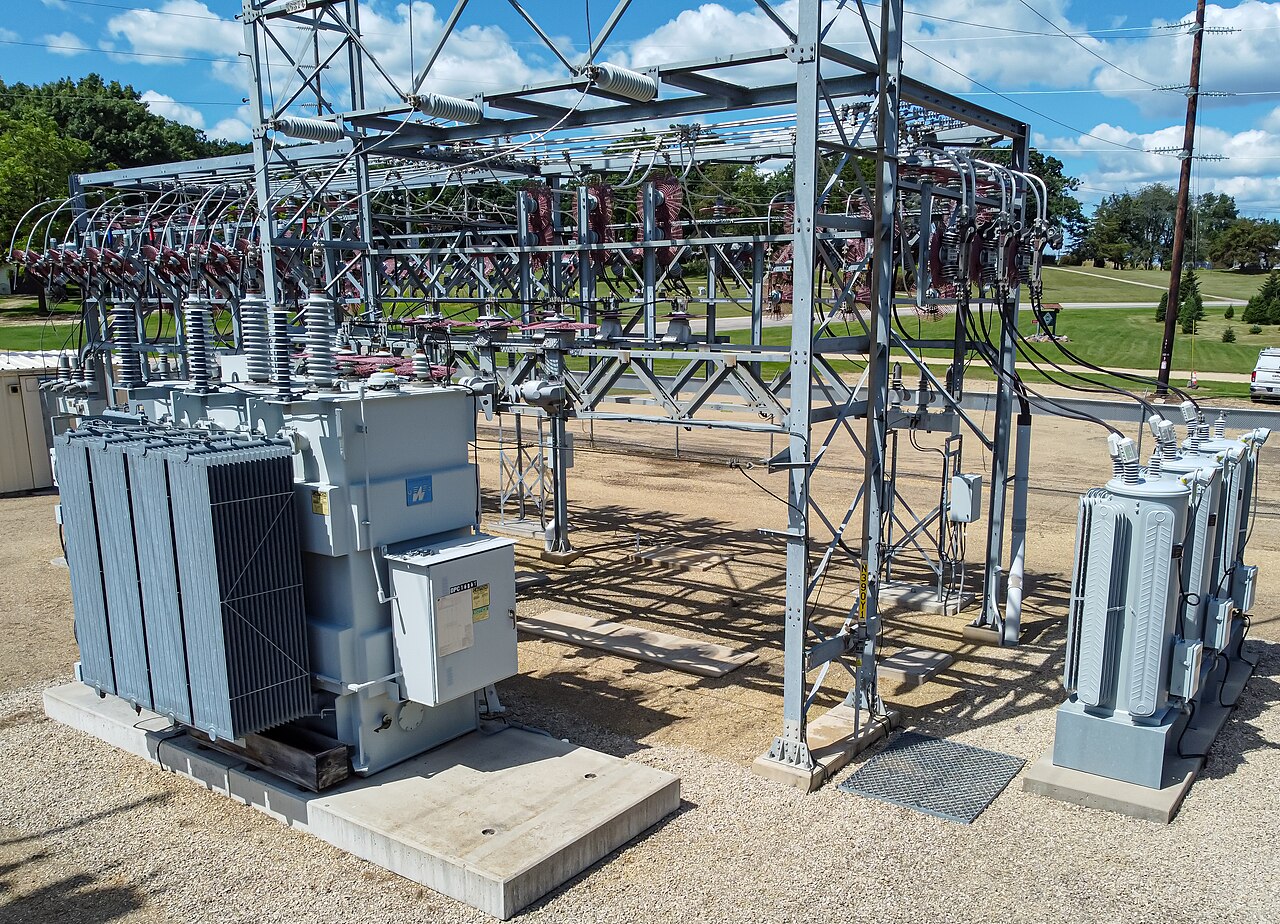
A power transformer at an electrical substation. Source: Wikimedia Commons (photo by Wikideas1), CC0 public domain dedication.
Quick Answer: Texas is the center of the national data center buildout, and its grid is feeling it. ERCOT set an all-time peak demand record of 91,134 megawatts on July 22, 2026, while roughly 474 gigawatts of large-load requests, about 90 percent of them data centers, sat in its interconnection process. As of November 15, 2026, new large data center energizations are paused while ERCOT audits those projects, with a report due to regulators on December 10.
How big is the Texas data center boom in grid terms?
The clearest measure is the gap between what the Texas grid has ever delivered and what developers say they want. The Electric Reliability Council of Texas (ERCOT), which manages the grid serving most of the state, told a Texas Senate panel on July 29, 2026 that large loads seeking interconnection totaled about 474 gigawatts (GW) as of June 2026, and that about 90 percent of that figure was data centers. The Governor’s office used the same numbers on August 3 and noted that the total is more than five times ERCOT’s record peak demand.
That record is itself new. ERCOT’s monthly operational report shows a preliminary all-time peak of 91,134 megawatts (MW) in the hour ending at 6 p.m. on July 22, 2026. The prior record, 85,508 MW, had stood since August 10, 2023. The U.S. Energy Information Administration described the new peak as about 6 percent above the old one and reported that natural gas supplied 48 percent and solar 32 percent of ERCOT generation at the time of the peak.
| Measure | Figure | Period and source |
|---|---|---|
| All-time ERCOT peak demand | 91,134 MW (preliminary) | July 22, 2026; ERCOT |
| Previous all-time peak | 85,508 MW | August 10, 2023; ERCOT |
| Large loads seeking interconnection | About 474 GW | June 2026; ERCOT |
| Share of those requests that are data centers | About 90 percent | June 2026; ERCOT |
| Large load approved to energize | 9,456 MW | September 2026 report; ERCOT |
| Large load observed operating | 4,132 MW | September 2026; ERCOT |
| Preliminary forecast of 2032 demand | About 367,790 MW | Filed April 15, 2026; ERCOT |
How much data center load is actually running today?
Far less than the queue suggests. ERCOT’s operational overview for September 2026 shows 9,456 MW of large load with approval to energize, a figure unchanged from July and August. Of that, ERCOT observed 4,132 MW of consumption in September, down slightly from 4,316 MW in August and 4,370 MW in July. Large loads in service therefore equal roughly 1 percent of the 474 GW that has been requested.
Did ERCOT set other demand records in 2026?
Yes. ERCOT reported a preliminary August record of 90,817 MW on August 24, 2026, which was 7,110 MW above the August 2025 peak, and a September record of 86,647 MW on September 12, up 6,698 MW from a year earlier. ERCOT’s reports do not break out how much of that growth came from data centers.
What does ERCOT’s long-term load forecast say?
On April 15, 2026, ERCOT filed a preliminary long-term load forecast for 2026 through 2032 with the Public Utility Commission of Texas (PUCT). It projects demand of approximately 367,790 MW in 2032, about four times the 2026 record.
ERCOT attached a strong caution. The forecast relies in part on figures utilities submit about medium loads (25 to 74.9 MW) and large loads (75 MW and above). ERCOT described it as a snapshot for planning, “not a prediction of what will be built,” and its chief executive said the grid operator believes the forecast is “higher than expected future load growth.” The PUCT is reviewing possible adjustments.
What does Senate Bill 6 require of large loads?
Senate Bill 6 is the 2025 Texas law written for this moment. According to legal summaries of the bill, the Legislature passed it on May 29, 2025 and Governor Greg Abbott signed it on June 20, 2025, with immediate effect. Its main provisions apply to loads of 75 MW or more at a single site and include:
- Study fee: at least $100,000 paid toward the initial transmission screening study.
- Disclosure: customers must say whether they are pursuing a substantially similar request elsewhere in Texas, and must disclose on-site backup generation equal to at least half of the proposed load.
- Curtailment: for large loads connected after December 31, 2025, utilities must have protocols that allow load to be curtailed during firm load shed events.
- Co-location review: since September 1, 2025, pairing a new large load with an existing power plant requires an ERCOT study of up to 120 days and a PUCT decision within 60 days after that.
What did the PUCT adopt to implement the law?
The commission adopted its large load interconnection standards on September 18, 2026 in Project 58481, creating a new section of its rules numbered 25.194. Legal and trade press analyses of the order describe these core terms:
- The rule covers new loads of 75 MW or more at a single site in the ERCOT region and qualifying expansions, with no carve-outs by industry.
- Customers post financial security of $50,000 per MW of requested peak demand before interconnection studies begin.
- A flat $100,000 study fee applies. The proposed rule published in March 2026 included a non-refundable fee of $50,000 per MW, which the commission dropped in the final version.
- Customers get a 24-month grace period on the energization schedule before security is applied to amounts owed.
At that rate, a 1,000 MW campus would post $50 million in security.
Why are new data center connections paused?
On August 3, 2026, Governor Abbott directed the PUCT and ERCOT to verify and audit every data center moving through the interconnection process before any project advances. His office said projects that fail to meet PUCT, ERCOT and state law requirements must be denied a grid connection. The directive asks each project about public incentives, on-site generation, water use, community impact and ownership.
The order landed in the middle of a redesign. ERCOT had retired its one-at-a-time large load study process on July 10, 2026 in favor of a group study called Batch Zero, which the PUCT approved in June. ERCOT paused final Batch Zero classifications and stopped approving energization of new large data centers and cryptocurrency mining facilities until the review is finished.
Two more directives followed. On September 14 the Governor wrote to the Texas Water Development Board about data center water-use reporting, and on September 21 he directed the Texas Commission on Environmental Quality to suspend permits sought by data centers until the reviews are complete, according to a White and Case summary of the letters.
What has the audit found so far?
ERCOT gave provisional Batch Zero classifications to transmission providers on September 3, 2026. Board materials show how much of the queue cleared even that first screen.
| Provisional Batch Zero status | Projects | Capacity |
|---|---|---|
| Conditionally included as base load | 204 | 66.4 GW |
| Conditionally included as studied load | 158 | 127.9 GW |
| Excluded | 373 | 302.2 GW |
Those figures are from ERCOT’s September 2026 board presentation, which lists the studied-load total as 127.9 GW in its summary and 125.4 GW in a chart.
On November 5, 2026, ERCOT updated the PUCT on verification. It had reviewed responses from 257 developers covering about 5,140 questions and expected to send second-round questions to about 80 percent of them, with five business days to respond. Its review was not finished, but it listed recurring problems: missing documentation of affiliate relationships, inability to demonstrate site control, inability to show that long-lead equipment will arrive before energization, and difficulty confirming the amount of financial security posted.
ERCOT’s verification report and community impact review are due to the commission on December 10, 2026. The Batch Zero study was originally due April 9, 2027; Utility Dive reported in August that ERCOT staff said that date will not be met.
Which Texas AI campuses are the largest verified projects?
| Campus | Stated size | Status per company sources |
|---|---|---|
| Crusoe, Abilene (Stargate flagship) | 1.2 GW, eight buildings, about 4 million square feet | Construction began June 2024; second phase expected complete by end of 2026 |
| Crusoe, Abilene expansion for Microsoft | 900 MW, two buildings | Announced March 27, 2026; first building expected mid-2027 |
| Vantage Frontier, Shackelford County | 1.4 GW, 10 data centers, 1,200 acres, more than $25 billion | Announced August 2025; first building scheduled for second half of 2026 |
| Google, Armstrong and Haskell counties | $40 billion, three data centers | Announced November 14, 2025 |
What is the status of Stargate in Abilene?
Crusoe is building the Abilene campus that OpenAI calls its flagship Stargate site. OpenAI said in September 2025 that the site was already running on Oracle Cloud Infrastructure. Crusoe describes eight buildings totaling 1.2 GW, with the first two energized in under a year and the remaining six expected to be complete by the end of 2026.
In March 2026 Crusoe announced an adjacent 900 MW campus for Microsoft, with two buildings each designed for 336 MW of critical IT load and a 900 MW behind-the-meter power plant with battery storage. Crusoe says that brings the Abilene site to about 2.1 GW in total.
What other large campuses are confirmed?
Vantage Data Centers announced Frontier in Shackelford County in August 2025: more than $25 billion for 1.4 GW across 10 data centers. OpenAI separately named Shackelford County and Milam County as Stargate sites, the latter developed with SoftBank and SB Energy. Google’s $40 billion plan covers one data center in Armstrong County and two in Haskell County, the Texas Tribune reported.
What does the data center sales tax exemption cost Texas?
The Texas Comptroller administers a state sales tax exemption for data centers that predates the AI boom. Under the Comptroller’s published rules, a qualifying data center needs at least 100,000 square feet, $200 million of capital investment within five years and 20 qualifying jobs. A qualifying large data center project needs at least 250,000 square feet, $500 million and 40 jobs. Certified facilities are exempt from the 6.25 percent state sales tax on items such as servers, cooling systems, generators and electricity for 10 to 20 years. Local sales tax still applies.
Texas Tribune reporting on Comptroller figures and July 2026 Senate Finance Committee testimony gives the fiscal picture. The exemption cost about $5.4 million in 2015. In 2025 the state projected $3.2 billion in forgone revenue over two years, and the Comptroller’s chief revenue estimator told senators the next estimate will be significantly higher. As of late July, 138 data centers had qualified, including 59 certified in 2026. Only 20 had been audited, and six of those were out of compliance. The Senate Finance chair has committed to filing a bill to reform or repeal it.
Brian’s Take
I spent years as an investment manager and analyst, and the first thing I look for in any boom is the difference between announced and delivered. Here it is stark. About 474 GW requested, 9,456 MW approved to energize, a little over 4,000 MW observed running. When ERCOT’s own audit says developers are struggling to show site control or confirm posted security, that tells me a lot of the queue was paper.
That does not make the boom fake. Abilene is real steel and real megawatts, and a 91,134 MW peak record is not a forecast. What I see is Texas trying to price seriousness: $50,000 per MW of security, disclosure of duplicate requests, and an audit before anyone else plugs in. In my view that is the kind of screen a market needs when demand claims run five times ahead of the system’s record.
The risk for Texas business is time. A pause with a December 10 report date and a study deadline that has already slipped creates uncertainty for the serious builders too. I would watch how quickly the state turns the audit into clear, final rules.
Frequently Asked Questions
How much power are data centers asking ERCOT for?
ERCOT reported about 474 GW of large loads seeking interconnection as of June 2026, with about 90 percent being data centers. That is more than five times the record peak demand of 91,134 MW.
What is ERCOT’s all-time peak demand record?
A preliminary 91,134 MW, set July 22, 2026. It replaced the 85,508 MW record from August 10, 2023.
Is there a moratorium on Texas data centers?
Energization of new large data centers and crypto mining facilities in ERCOT is paused while ERCOT completes a verification and audit ordered by the Governor on August 3, 2026. ERCOT’s reports are due December 10, 2026.
How much financial security must a large load post?
Under the rule the PUCT adopted on September 18, 2026, $50,000 per MW of requested peak demand, plus a flat $100,000 study fee.
Sources and Further Reading
- Monthly Operational Overview, July, August and September 2026, ERCOT
- Senate Panel Presentation: Assessing the Grid, July 29, 2026, ERCOT
- Item 14: Batch Zero Update, Board of Directors, September 2026, ERCOT
- Verification RFI Update, November 5, 2026, ERCOT
- ERCOT Releases Preliminary Long-Term Load Forecast, April 15, 2026, ERCOT
- Governor Abbott Directs Comprehensive Data Center Audit, August 3, 2026, Office of the Texas Governor
- Today in Energy: ERCOT hourly peak load record, August 3, 2026, U.S. Energy Information Administration
- State Sales Tax Exemption for Qualifying Data Centers, Texas Comptroller of Public Accounts
- PUCT Sets Financial Commitments for Data Center Interconnection, September 25, 2026, White and Case
- Coverage of PUCT interconnection rules and the ERCOT audit, Utility Dive
- Texas Senate Bill 6 Ushers Major Overhaul of Large Load Interconnection, Bracewell via National Law Review
- Abilene campus announcements, March 2025 and March 2026, Crusoe
- Vantage Data Centers Unveils Plans for Frontier, August 19, 2025, Vantage Data Centers via Business Wire
- Five New Stargate Sites, September 23, 2025, OpenAI
- Reporting on data center tax exemptions, ERCOT and Google, The Texas Tribune