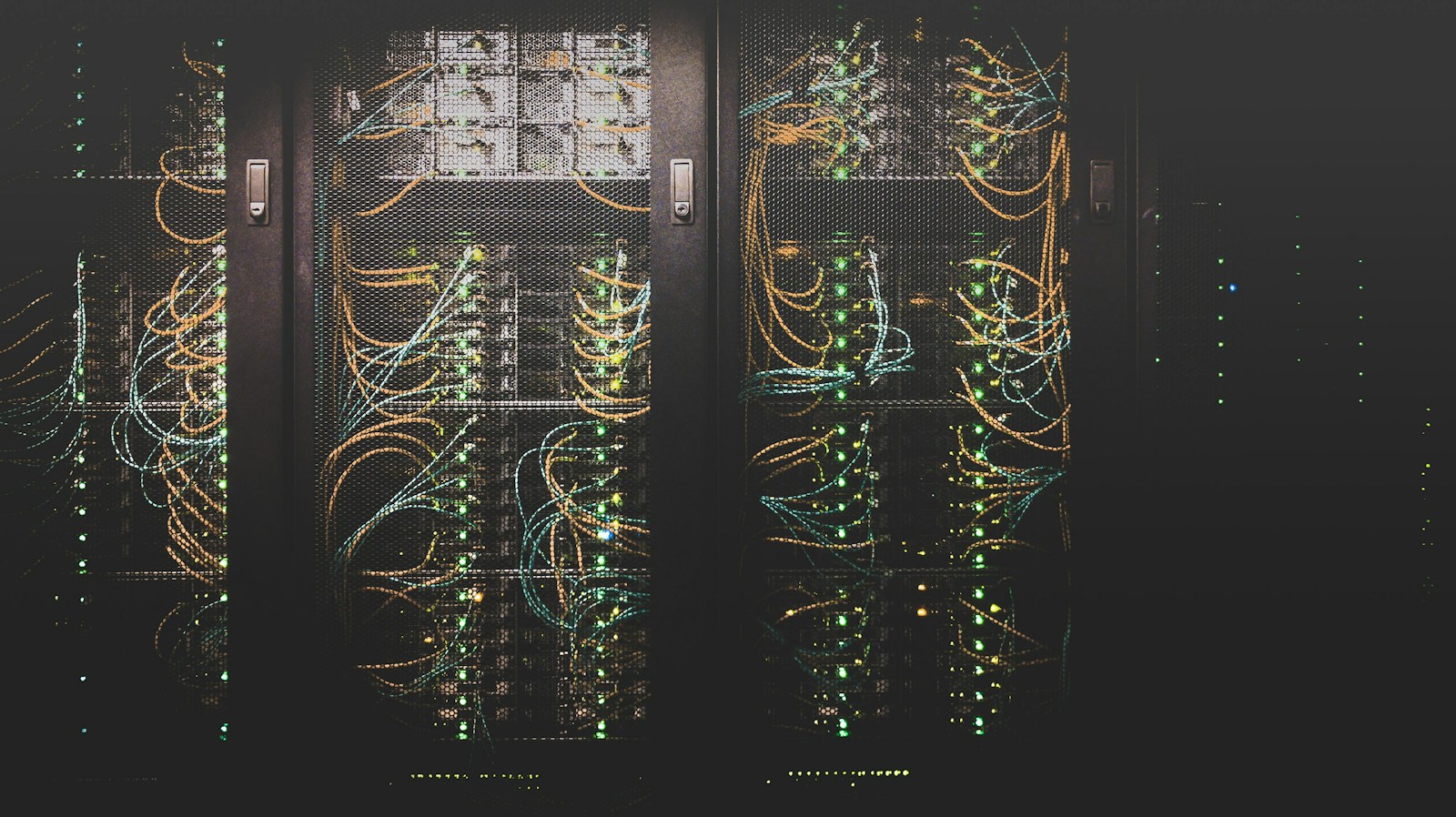
Generic data center hardware, not the Horizon system. Photo: Taylor Vick / Unsplash (Unsplash License).
Quick Answer: Horizon, the National Science Foundation supercomputer run by the Texas Advanced Computing Center at the University of Texas at Austin, opened to early users on November 17, 2026 and entered the November 2026 TOP500 list at No. 24 worldwide with 132 petaflops. The machine anchors a federal project with an authorized cost of $457.4 million. It arrives as Texas universities report $9.15 billion in fiscal 2024 research spending, third among the states, and as the Texas University Fund paid out $209.2 million in fiscal 2026.
What is Horizon and what is its status in November 2026?
Horizon is the main system of the NSF Leadership-Class Computing Facility, a national research computing project led by the Texas Advanced Computing Center, known as TACC, at UT Austin. The university announced on November 17, 2026 that the system had opened to early users, who get first access to its graphics processor partition.
The system is being delivered in two phases. Phase one consists of 4,000 graphics processing units on the NVIDIA Grace Blackwell platform and is the part now in service. Phase two adds servers built on NVIDIA Vera central processors and is scheduled for early 2027, according to UT Austin. TACC has previously described the finished system as having about 1 million processor cores alongside the 4,000 GPUs.
Horizon replaces Frontera, which UT Austin says was retired in October 2026 after more than seven years of service. Frontera entered production in June 2019 and completed more than 8 million jobs.
Where does Horizon rank among the world’s supercomputers?
On the November 2026 TOP500 list, Horizon is No. 24 in the world with a measured result of 132 petaflops on the High Performance Linpack benchmark, using 144,000 cores. That result reflects the first phase only. It is the highest-ranked system at a United States university on the list. The American machines above it belong to Department of Energy national laboratories or to companies.
Frontera’s last listed result was 23.52 petaflops, which means the partial Horizon system already measures about 5.6 times its predecessor on that benchmark. UT Austin gives Horizon’s figures as 140 peak petaflops for the GPU partition and roughly 180 petaflops projected once the processor partition is added. Earlier TACC material, published in November 2025 and again in a May 2026 presentation by the center’s director, cited a target of about 300 petaflops.
For artificial intelligence work, the university lists 20 exaflops at 16-bit precision and 80 exaflops at 4-bit precision, which it describes as more than 100 times the capability of existing academic systems.
What hardware is inside the system?
| Item | Figure | Source and date |
|---|---|---|
| Phase one accelerators | 4,000 NVIDIA Grace Blackwell GPUs | UT Austin, November 2026 |
| Phase two processors | NVIDIA Vera CPU servers, early 2027 | UT Austin, November 2026 |
| Measured benchmark result | 132 petaflops, No. 24 worldwide | TOP500, November 2026 |
| Storage | 400 petabytes, all solid state | UT Austin, November 2026 |
| Data center | 20 megawatts, liquid cooled, Round Rock | UT Austin, November 2026 |
| Floor layout | 128 cabinets: 28 GPU, 66 CPU, 34 storage and network | TACC briefing, May 2026 |
| Archive | Ranch, more than 1 exabyte | TACC, November 2025 |
The machine does not sit on the UT campus. It occupies a hall built to TACC’s specifications inside a Sabey Data Centers building in Round Rock, north of Austin. The May 2026 briefing put Horizon’s expected electrical draw at roughly 13 megawatts, about double the 6 megawatts Frontera used. Each GPU rack holds 144 GPUs and draws about 215 kilowatts. Dell Technologies, NVIDIA and VAST Data are the named technology suppliers.
How much does the Leadership-Class Computing Facility cost and who pays?
The National Science Foundation funds construction under award number 2323116. A Government Accountability Office review of NSF’s major facilities, released February 24, 2026, lists the project’s authorized total cost at $457.4 million and its estimated completion date as March 2028, based on data as of July 2025. The review found no schedule change since June 2024.
The federal commitment extends beyond construction. The May 2026 TACC briefing put NSF’s commitments tied to the facility at about $1 billion over 10 years, covering operations as well as the build. It put the price of a single Blackwell GPU node at about $120,000, compared with $6,000 to $8,000 per node for large clusters over the previous two decades.
State money plays a smaller part. UT Austin said in November 2025 that the Texas Legislature had appropriated $20 million toward part of its AI computing purchase. With Horizon in service, UT Austin counts nearly 5,500 GPUs across TACC.
Is the project on schedule?
The system is running later than first advertised but inside the federal baseline. In November 2025, TACC said Horizon was scheduled to enter production in spring 2026. By the center’s own account in July 2026, the GPU racks were operational and 11 research teams in its Characteristic Science Applications program were using them for acceptance testing, with the processor partition expected in winter 2026 or early 2027. Early user access followed on November 17, 2026. The processor partition is now due about a year before the March 2028 completion date in the federal review.
Access is free to researchers but competitive. TACC says the system is open to scientists and engineers at United States institutions, with time awarded through peer review, and that the facility is expected to support 10,000 to 15,000 users a year.
What other large computing systems do Texas universities run?
TACC’s current fleet, as listed by UT Austin, is Horizon, Vista, Lonestar6, Stampede3, Jetstream2, Ranch and Corral.
The second-largest university machine in the state belongs to the Texas A&M University System. Its supercomputer, named VISION, is an NVIDIA DGX SuperPOD with 95 nodes and 760 H200 GPUs, housed at the university’s West Campus Data Center. The system’s Board of Regents approved $45 million for the computing investment. VISION debuted at No. 66 on the June 2026 TOP500 list with 34.82 petaflops, at that point the highest ranking for a university-operated machine in the United States. On the November 2026 list it stands at No. 74, behind Horizon. It serves researchers across the A&M System’s 12 universities and eight state agencies.
Other campuses are building at smaller scale. Texas Tech University announced in February 2026 a partnership with NVIDIA to install GB300 NVL72 systems based on the Blackwell Ultra platform in Lubbock, without disclosing the cost or GPU count. The University of Texas at Arlington unveiled a $2.1 million research computing cluster in July 2025.
How much research do Texas universities perform?
The benchmark is the NSF Higher Education Research and Development survey. The latest edition, covering fiscal 2024, was released December 23, 2025. It shows institutions in Texas spent $9.15 billion on research and development that year, up 9.8 percent from $8.33 billion in fiscal 2023 and $7.50 billion in fiscal 2022. Texas ranked third among the states, behind California at $14.37 billion and New York at $9.63 billion and ahead of Maryland at $6.57 billion. The state accounted for about 7.8 percent of the national total.
National spending reached $117.7 billion, up 8.1 percent, so Texas grew faster than the country as a whole.
Which Texas institutions rank highest?
| Institution | U.S. rank | FY 2024 total | Federally funded |
|---|---|---|---|
| Texas A&M University (with Health Science Center) | 22 | $1,393.8 million | $582.7 million |
| UT MD Anderson Cancer Center | 23 | $1,363.3 million | $282.4 million |
| UT Austin | 31 | $1,143.9 million | $690.8 million |
| Baylor College of Medicine | 42 | $881.2 million | $453.7 million |
| UT Southwestern Medical Center | 43 | $869.3 million | $359.7 million |
| UTHealth Houston | 84 | $419.1 million | $227.1 million |
| Rice University | 117 | $277.7 million | $127.6 million |
| Texas Tech University | 124 | $256.9 million | $62.9 million |
| University of Houston | 132 | $239.0 million | $104.0 million |
| UT Dallas | 146 | $181.8 million | $82.4 million |
Three Texas institutions each exceeded $1 billion, and the five largest together spent about $5.65 billion, roughly 62 percent of the state total. Texas A&M’s total rose 9.1 percent from fiscal 2023, UT Austin’s rose 10.4 percent and MD Anderson’s rose 8.6 percent. UT Dallas posted one of the fastest gains among the larger campuses, up 23.9 percent to $181.8 million.
UT Austin drew the most federal research money in the state at $690.8 million, and ranked first in the nation for NSF-funded research at $176.4 million, according to the university. Texas A&M ranked third nationally in engineering research at $496.8 million, with UT Austin fifth at $418.9 million.
What do newer figures show?
Both flagships have reported fiscal 2025 results ahead of the federal survey. Texas A&M reported $1.433 billion, up $39 million or 2.8 percent, with federal sources at $562 million or 39 percent of the total. UT Austin reported $1.37 billion, up from $1.14 billion. NSF’s statistical agency lists November 24, 2026 as the scheduled release date for the fiscal 2025 survey, which will show whether the national rankings changed.
What does the Texas University Fund add?
The Texas University Fund is the state’s endowment for emerging research universities outside the Permanent University Fund, which supports the UT and A&M systems. According to a July 2026 Legislative Budget Board presentation to the Senate Higher Education Committee, the 88th Legislature provided $2.5 billion in general revenue and transferred the balances of the former National Research University Fund, creating a corpus of $3.0 billion. The Texas Treasury Safekeeping Trust Company invests it.
Four universities currently qualify. Distributions have grown 53 percent in two years.
| Institution | FY 2024 | FY 2025 | FY 2026 |
|---|---|---|---|
| University of Houston | $48.3 million | $63.8 million | $58.8 million |
| Texas Tech University | $44.4 million | $60.1 million | $55.2 million |
| University of North Texas | $21.3 million | $29.1 million | $47.8 million |
| Texas State University | $22.4 million | $30.3 million | $47.4 million |
| Total | $136.4 million | $183.3 million | $209.2 million |
Under the fund’s rules, 75 percent of each distribution goes to base funding for a permanent endowment for education and research and 25 percent to research performance funding. Within the performance share, 85 percent is tied to federal and private research expenditures and 15 percent to research doctoral degrees awarded. That formula explains the fiscal 2026 shift, in which North Texas and Texas State gained sharply while Houston and Texas Tech received less than the year before.
More campuses are approaching eligibility. The fiscal 2027 thresholds are a three-year average of $21.7 million in qualifying research expenditures and 45 research doctoral degrees. Texas A&M University-Corpus Christi averaged $25.9 million and 40 doctorates over 2023 through 2025, clearing the spending bar but not the degree count. Texas A&M University-Kingsville averaged $20.4 million and 24 doctorates.
Frequently Asked Questions
Is Horizon the fastest university supercomputer in Texas?
It is the top-ranked university system in the United States on the November 2026 TOP500 list, at No. 24 with 132 petaflops. Texas A&M’s VISION is No. 74 with 34.82 petaflops.
How much did Horizon cost?
No separate price for the machine has been published. The NSF Leadership-Class Computing Facility project that includes it has an authorized total cost of $457.4 million, according to the Government Accountability Office.
When will Horizon be finished?
The GPU phase opened to early users on November 17, 2026. The processor phase is scheduled for early 2027. The federal project’s estimated completion date is March 2028.
Which Texas university spends the most on research?
Texas A&M University, at $1.39 billion in fiscal 2024, ranked 22nd nationally.
Which schools receive Texas University Fund money?
The University of Houston, Texas Tech University, the University of North Texas and Texas State University. They shared $209.2 million in fiscal 2026.
Sources and Further Reading
- Horizon Opens to Early Users: America’s Most Powerful Academic Supercomputer Begins Serving Science – UT News, University of Texas at Austin
- TOP500 List, November 2026 – TOP500
- NSF LCCF Horizon Supercomputer To Power Breakthroughs for the Nation’s Leading Scientists – Texas Advanced Computing Center
- Opening The Future of Science – Texas Advanced Computing Center
- An Update on the NSF Leadership Class Computing Facility, TACC and HPC in the AI World (May 2026) – HPC User Forum
- National Science Foundation: Schedule Delays Continue for Some Major and Midscale Research Infrastructure Projects (GAO-26-107842) – U.S. Government Accountability Office
- UT Eclipses 5,000 GPUs To Increase Dominance in Open-Source AI, Strengthen Nation’s Computing Power – UT News, University of Texas at Austin
- Higher Education Research and Development: Fiscal Year 2024, Tables 6, 21, 22 and 25 – National Center for Science and Engineering Statistics, National Science Foundation
- Schedule of Release Dates – National Center for Science and Engineering Statistics
- UT Ranks No. 1 in U.S. for Research Funded by National Science Foundation – UT News, University of Texas at Austin
- Texas A&M Is the No. 1 Research University in Texas, Top 25 Nationally – Texas A&M Stories
- Texas A&M Reports Record $1.433 Billion in FY25 Research Expenditures – Texas A&M University Office of the Provost
- Texas A&M System Home to Nation’s Fastest University Supercomputer – Texas A&M University System
- From West Texas to the World: Texas Tech Launches Next-Generation AI Infrastructure – Texas Tech University
- UTA Unveils Supercomputing Research Hub – University of Texas at Arlington
- Higher Education Funds Overview (July 2026) – Legislative Budget Board