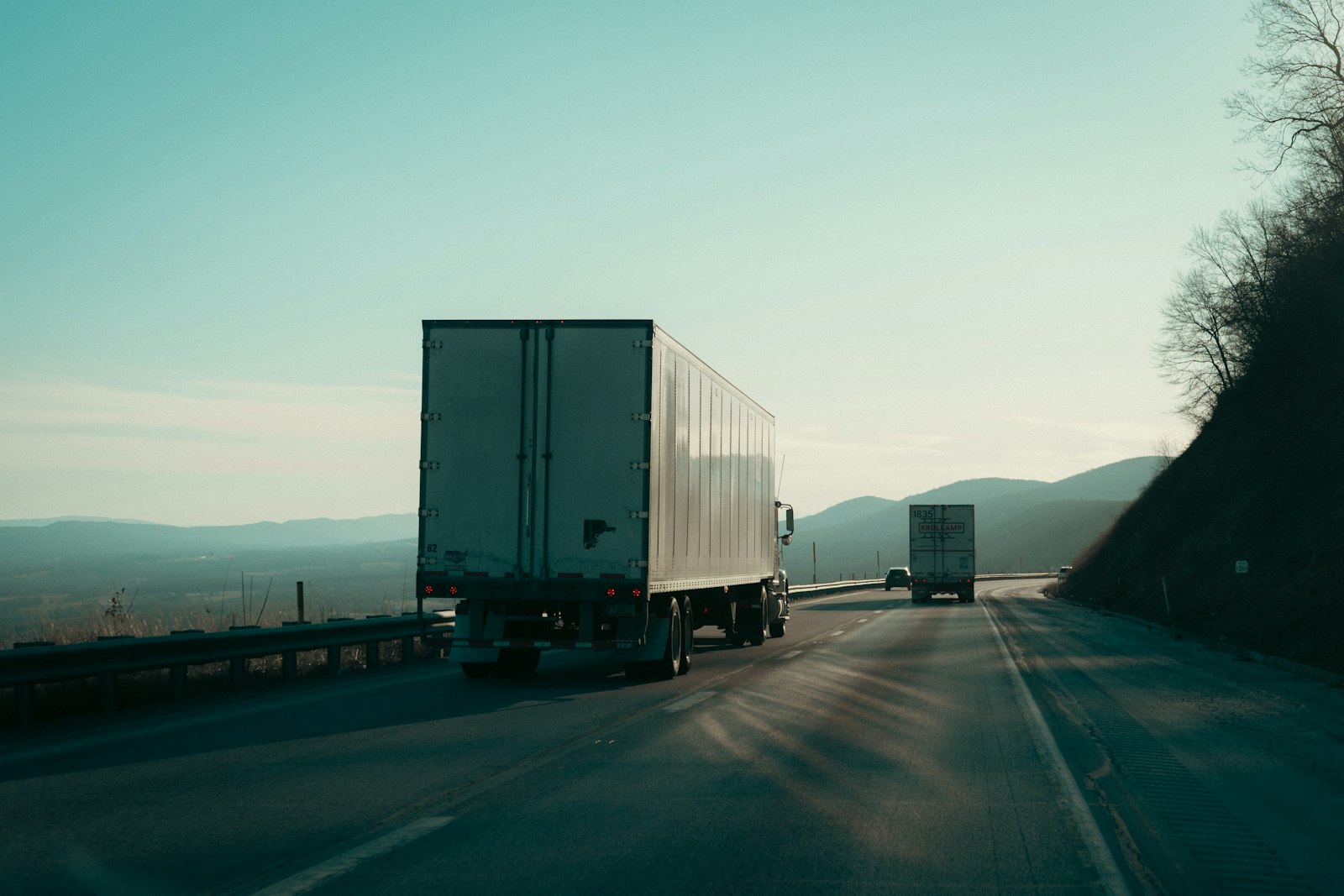
Semi-trucks on a highway. Photo: Bhargav Panchal / Unsplash (Unsplash License).
Quick Answer: Aurora Innovation, the driverless trucking company whose commercial operations are centered on Texas freight lanes, reported third-quarter 2026 revenue of $3 million and a net loss of $234 million on October 28, 2026. The company cut its 2026 revenue forecast to about $9 million after a six-week manufacturing delay, but said it still expects 200 trucks by the end of February and more than 1,000 on the road by the end of 2027. A new 500-truck memorandum of understanding with Charger Logistics builds on freight the carrier already moves between Dallas and Laredo.
What did Aurora report for the third quarter of 2026?
Aurora Innovation released its third-quarter results on October 28, 2026, and held its business review call that afternoon. The headline numbers show a company that is still tiny in revenue terms and very large in spending terms, which is what a pre-scale autonomous trucking business looks like in the months before its fleet arrives.
According to FreightWaves’ report on the quarter, revenue rose to $3 million from $1 million a year earlier. The operating loss widened to $257 million from $222 million, a figure that included $54 million of stock-based compensation. The net loss was $234 million, or 12 cents a share, compared with $201 million, or 11 cents a share, in the third quarter of 2025.
The company used about $170 million of cash in operations during the quarter and spent $36 million on capital expenditures, which management described as within its quarterly average target. Aurora’s release said it ended the quarter with more than $1 billion in cash and short-term investments. FreightWaves put the figure at just over $1 billion at the end of September, down from nearly $1.2 billion at the end of June.
| Measure | Q3 2026 | Q3 2025 |
|---|---|---|
| Revenue | $3 million | $1 million |
| Operating loss | $257 million | $222 million |
| Net loss | $234 million | $201 million |
| Net loss per share | 12 cents | 11 cents |
| Cash used in operations | About $170 million | Not reported in sources reviewed |
| Capital expenditures | $36 million | Not reported in sources reviewed |
| Cash and short-term investments | More than $1 billion | Not reported in sources reviewed |
Sources: Aurora Innovation third-quarter 2026 release; FreightWaves, October 30, 2026.
Why did Aurora cut its 2026 revenue forecast?
The most consequential number in the report was a guidance cut. Aurora lowered its 2026 revenue forecast to about $9 million, down from the $14 million to $16 million range it gave with second-quarter results. Measured against the midpoint of the earlier range, that is a reduction of roughly 40%.
FreightWaves attributed the cut to a six-week manufacturing delay. Chief executive Chris Urmson told Bloomberg, as quoted by FreightWaves, “Instead of producing 20 trucks a week in October, we’re going to do that in December.” Because Aurora is paid as trucks haul freight, every week a truck arrives late is revenue that moves out of 2026 and into 2027.
The delay did not change the company’s stated destination. Urmson said on the call, “We still expect to get 200 trucks out of this in February.” FreightWaves reported that the initial 200 trucks are fully contracted.
How many driverless trucks does Aurora have, and how fast is the fleet growing?
Aurora’s release said it has more than 20 driverless trucks already built and coming into the fleet. That is the starting point for a production ramp that the company describes in weekly terms rather than annual ones.
The trucks are upfitted by Roush in Livonia, Michigan. FreightWaves reported that Roush is expected to reach 20 trucks per week in early December, is adding a second shift, and is on track to deliver 200 trucks by the end of February. Fabrinet supplies the Aurora Driver hardware kits. An Aurora executive identified in the FreightWaves report as Maday said the line can be pushed beyond 20 trucks a week by expanding it, adding that “there is nothing that is really prohibiting us from hitting the run rate at this point.”
Aurora’s release put its annualized capacity at more than 1,000 trucks. Urmson referred on the call to the “1,000+ trucks we expect on the road by the end of next year,” which FreightWaves tied to the end of 2027.
| Milestone | Stated target or status |
|---|---|
| Driverless trucks built and entering the fleet | More than 20 |
| Roush production rate | 20 trucks per week in early December 2026 |
| Initial fleet | 200 trucks by the end of February, fully contracted |
| Annualized capacity | More than 1,000 trucks |
| Trucks on the road | More than 1,000 by the end of 2027 |
| Volvo Autonomous Solutions launch | First quarter of 2027; more than 300 trucks that year |
| Third-generation hardware kit (AUMOVIO) | Production to start in the second half of 2027 |
| Driverless customers | 10 |
Sources: Aurora Innovation third-quarter 2026 release; FreightWaves, October 30, 2026.
What role do truck makers play in the ramp?
The Roush line is a bridge. Aurora’s release said the company is preparing for full industrialization with Volvo and PACCAR and is integrating its driver on Volvo’s factory line. FreightWaves reported that Volvo Autonomous Solutions plans a driverless launch with the Aurora Driver in the first quarter of 2027, with more than 300 trucks deployed that year. AUMOVIO is scheduled to begin producing Aurora’s third-generation hardware kit in the second half of 2027.
Which Texas freight lanes are tied to Aurora’s growth?
Texas is where Aurora’s driverless product first carried freight, and the customer agreements disclosed this quarter keep the state at the center of the plan.
The clearest example is the Dallas to Laredo corridor. Aurora’s release announced a non-binding memorandum of understanding under which Charger Logistics would own and operate 500 Aurora Driver-powered trucks under the company’s Driver as a Service model, with deliveries expected in 2027 and 2028. FreightWaves reported that the MOU builds on a July agreement covering freight between Dallas and Laredo, which was described as potential multiyear revenue in the hundreds of millions of dollars.
Charger president Andy Khera, quoted in Aurora’s shareholder letter as reported by FreightWaves, said, “Since launching autonomous operations along the Laredo corridor, we’ve realized immediate operational benefits.”
Laredo matters because it is the Texas end of a major cross-border freight corridor, and Dallas is the distribution hub at the other end of the lane. A driverless truck that can run that route repeatedly is working one of the most heavily used truck lanes in the state.
How does this compare with Aurora’s Texas footprint a year ago?
The year-ago picture offers a useful baseline. In its third-quarter 2025 business review, as reported by FreightWaves on October 30, 2025, Aurora said it had logged more than 100,000 driverless miles on public roads. Its trucks were running between Dallas-Fort Worth and Houston, and it had added a route of approximately 600 miles from Fort Worth to El Paso. At that time the company said an expansion to Phoenix was slated for January 2026 and described a Fort Worth to Phoenix run of about 1,000 miles.
Aurora also said then that it aimed to exit 2026 with hundreds of driverless trucks. Twelve months later, the company has more than 20 built and entering service, with 200 now expected by the end of February. The sources reviewed for this article did not include an updated 2026 driverless mileage total.
Which customers have committed to trucks?
FreightWaves reported that the Charger MOU follows a 500-truck MOU with Hirschbach Motor Lines signed in April, bringing announced MOUs to 1,000 trucks. Maday told analysts the two agreements are expected to convert at pricing and volumes already agreed, saying, “On the two MOUs, we fully expect these to convert.” He also said Aurora has 10 driverless customers.
Aurora’s release lists the companies it works with across the industry as AUMOVIO, FedEx, Hirschbach, McLane, NVIDIA, PACCAR, Ryder, Schneider, Toyota, Uber, Uber Freight, Volvo Trucks, Volvo Autonomous Solutions and Werner. The release does not detail the work with each company.
One operational change is due this month. FreightWaves reported that in November, Aurora trucks begin running directly to customer sites for several driverless customers, which includes navigating security checkpoints. Until now the model has relied on terminals at each end of a lane.
What regulatory changes help driverless trucks in Texas?
Two developments in the quarter address practical problems that a truck with no driver has to solve on a Texas interstate.
First, the Federal Motor Carrier Safety Administration granted Aurora a five-year exemption on October 7, 2026. According to Aurora’s release, it permits cab-mounted warning beacons in place of the warning devices a human driver would set out by hand behind a stopped truck. The release said the regulator found the approach equivalent to or greater than the legacy requirements. FreightWaves reported that other Level 4 autonomous carriers may use the exemption after notifying the agency.
Second, Aurora now uses what it calls an enhanced pre-trip inspection approach, which FreightWaves said lets the system determine whether a weigh station is open and pull into a scale lane. Urmson described it on the call this way: “EPTI is a really useful tool that allows you to have certainty and bypass weigh stations.”
How long can Aurora fund its losses?
Aurora did not give a cash runway in the sources reviewed, but it gave enough to frame the question. With just over $1 billion on hand, the company expects fourth-quarter cash use of about $250 million, which is higher than the third quarter’s combined operating cash use and capital spending of roughly $206 million.
Maday said the increase was expected. “The vast majority of the increase is planned, it has been expected, and it is all related to building up the fleet,” he said, according to FreightWaves. He added that research and development spending will change little in the fourth quarter, while some added general and administrative cost is expected to support hundreds of trucks.
During the quarter Aurora sold 6 million shares through its at-the-market program for $41 million in net proceeds, of which $23 million was used to cover taxes on vesting employee stock. FreightWaves, citing reporting by Bloomberg, said Maday expects positive cash flow in 2028, with more revenue and fewer assets on the company’s books.
That last phrase points to the business model. Under Driver as a Service, carriers such as Charger own and operate the trucks, and Aurora supplies the driver. If the MOUs convert as management expects, the fleet growth of 2027 and 2028 would sit largely on customers’ balance sheets.
What should Texas shippers and carriers watch next?
The next several months contain a series of dated checkpoints. Roush is due to reach 20 trucks a week in early December. The 200-truck initial fleet is due by the end of February. Volvo’s launch is planned for the first quarter of 2027. Deliveries under the Charger MOU are expected in 2027 and 2028, and third-generation hardware production is scheduled for the second half of 2027.
For Texas carriers, the practical question is whether the Dallas to Laredo corridor and the lanes Aurora described a year ago can absorb hundreds of driverless trucks on the schedule management has laid out. For shippers, the move to direct customer-site deliveries will show whether driverless service can work without a terminal handoff at each end. And for investors, the gap between about $9 million in expected 2026 revenue and quarterly cash use of about $250 million is the measure of how much depends on that ramp.
Frequently Asked Questions
How much revenue did Aurora report in the third quarter of 2026?
Aurora reported revenue of $3 million, up from $1 million a year earlier, with a net loss of $234 million, or 12 cents a share.
What is Aurora’s 2026 revenue forecast?
About $9 million, reduced from a prior range of $14 million to $16 million after a six-week manufacturing delay.
How many driverless trucks will Aurora have?
The company says more than 20 are built and entering the fleet, 200 are expected by the end of February, and more than 1,000 are expected on the road by the end of 2027.
Which Texas route is linked to the Charger Logistics agreement?
The 500-truck memorandum of understanding builds on a July agreement for freight moving between Dallas and Laredo.
When does Aurora expect positive cash flow?
Management has pointed to 2028, according to FreightWaves’ account of Bloomberg reporting.
What did federal regulators approve in October 2026?
The Federal Motor Carrier Safety Administration granted a five-year exemption on October 7, 2026, allowing cab-mounted warning beacons in place of manually placed warning devices.
Sources and Further Reading
- Aurora Announces Third Quarter 2026 Results, Aurora Innovation (Business Wire), October 28, 2026
- Aurora reaffirms it’s on track to produce more than 1000 trucks in 2027, FreightWaves, October 30, 2026
- Aurora expands driverless routes to El Paso, FreightWaves, October 30, 2025