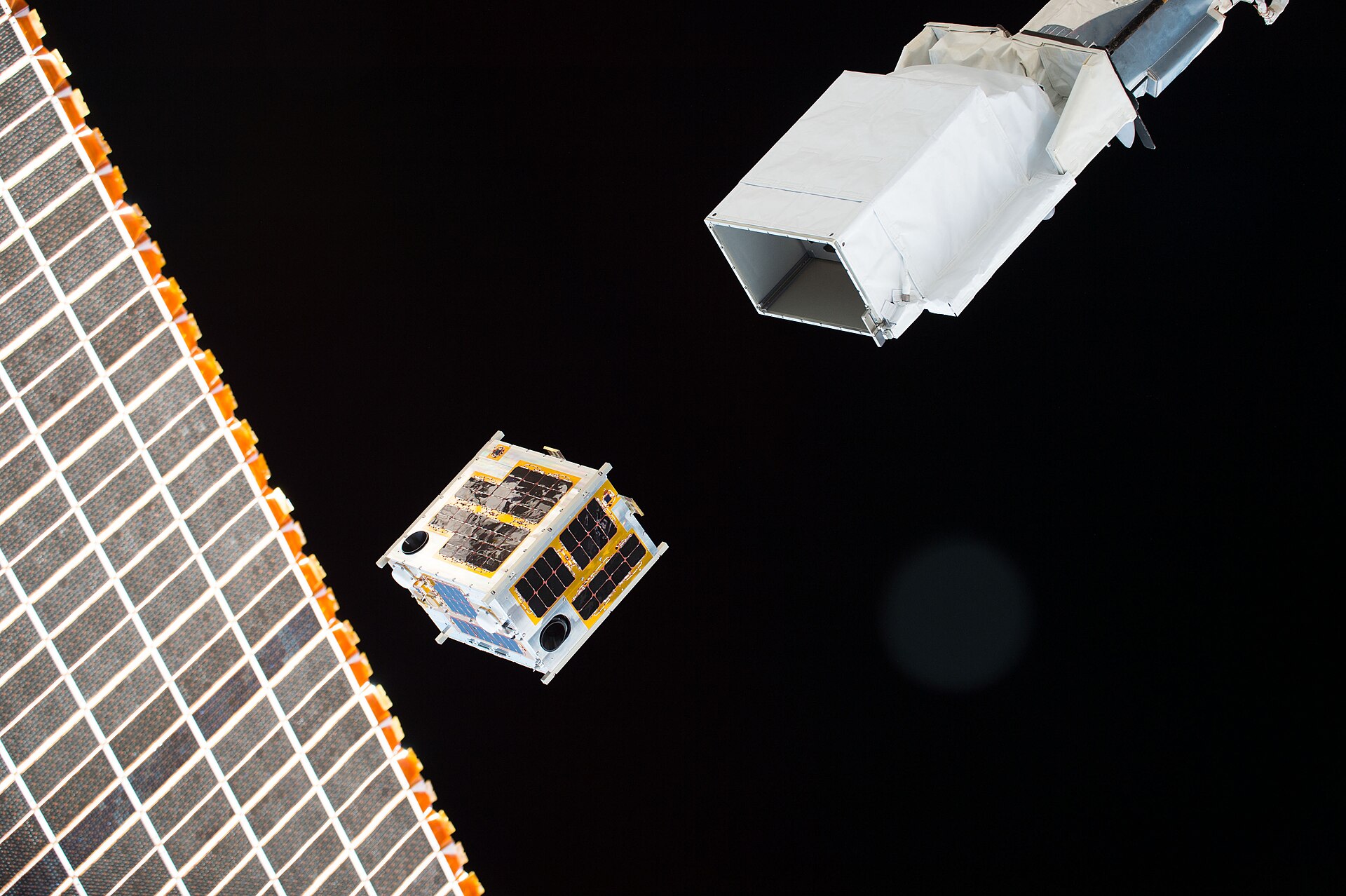
Image: NASA via Wikimedia Commons, ISS-47 Diwata-1 satellite deployment.jpg (Public domain).
Quick Answer: AST SpaceMobile, the Midland, Texas company building a cellular broadband network in space, reported third-quarter 2026 revenue of $42.3 million, nearly three times the $14.7 million of a year earlier, and a net loss attributable to common stockholders of $132.4 million. It ended September with about $3.2 billion in cash and restricted cash, kept its full-year revenue target of $150 million to $200 million, and said it expects to have about 45 BlueBird satellites in orbit by the middle of 2027.
What did AST SpaceMobile report for the third quarter?
AST SpaceMobile released its business update and third-quarter results on November 9, 2026, under a Midland, Texas, dateline. The company designs and builds large satellites intended to connect directly to ordinary, unmodified smartphones, working with mobile network operators rather than competing with them.
Revenue for the quarter ended September 30 was $42.3 million, compared with $14.7 million in the third quarter of 2025. The company attributed the revenue to gateway deliveries and U.S. government milestones. Revenue for the first nine months of 2026 reached $88.6 million, against $16.6 million in the same period of 2025.
The company remains deep in its investment phase. Total operating expenses under generally accepted accounting principles were $211.0 million, roughly five times revenue, and the net loss attributable to common stockholders was $132.4 million, or 44 cents per Class A share. That per-share loss compares with 45 cents a year earlier.
| Headquarters | Midland, Texas |
| Chairman and CEO | Abel Avellan |
| Release date | November 9, 2026 |
| Revenue | $42.3 million |
| GAAP operating expenses | $211.0 million |
| Adjusted operating expenses | $133.6 million |
| Net loss to common stockholders | $132.4 million |
| Loss per Class A share | $0.44 |
| Cash, equivalents and restricted cash | About $3.2 billion |
| Long-term debt, net | $4.08 billion |
| 2026 revenue target | $150 million to $200 million |
Where did the revenue come from?
The income statement splits revenue almost evenly between products and services. Products revenue, which reflects hardware such as the ground gateways that link satellites to carrier networks, was $20.6 million, up from $7.7 million. Services revenue was $21.8 million, up from $7.0 million.
| Line item | Q3 2026 | Q3 2025 |
|---|---|---|
| Products revenue | $20,571 | $7,746 |
| Services revenue | $21,750 | $6,993 |
| Total revenue | $42,321 | $14,739 |
| Cost of revenues, products | $22,451 | $5,511 |
| Cost of revenues, services | $2,863 | None reported |
| Engineering services | $95,788 | $40,836 |
| General and administrative | $55,705 | $29,822 |
| Research and development | $9,094 | $5,530 |
| Depreciation and amortization | $25,078 | $12,716 |
| Total operating expenses | $211,026 | $94,415 |
Two details in the table are worth noting. Products cost of revenues, at $22.5 million, slightly exceeded products revenue of $20.6 million, meaning the company is not yet earning a gross profit on hardware. Services, by contrast, carried a cost of revenues of just $2.9 million against $21.8 million of revenue.
Can the company reach its full-year revenue target?
AST SpaceMobile said it remains on target for full-year 2026 revenue of $150 million to $200 million, and pointed to potential upside based on recent contract signatures. With $88.6 million booked through nine months, simple arithmetic shows the fourth quarter would need to deliver at least about $61 million to reach the bottom of the range and about $111 million to reach the top. Either figure would be the largest quarter in the company’s history by a wide margin.
How much is the company spending?
Operating expenses of $211.0 million were down $118.1 million from the second quarter’s $329.1 million. The company said the decline was mainly because the second quarter included a $125.9 million loss on involuntary conversion. The cash flow statement separately records $32.4 million of insurance proceeds related to the BlueBird 7 launch.
Setting aside that one-time item, spending is rising. Adjusted operating expenses, which exclude depreciation, amortization and stock-based compensation, were $133.6 million, up $14.5 million from $119.1 million in the second quarter. Engineering services, the largest line at $95.8 million, more than doubled from a year earlier and made up about 45 percent of total operating expenses.
Capital spending is larger still. Purchases of property and equipment totaled $1.15 billion in the first nine months of 2026, compared with $669 million in the same period of 2025. Gross capitalized property and equipment stood at about $2.6 billion at September 30. Fierce Network reported that Chief Financial Officer Andy Johnson told analysts to expect fourth-quarter capital expenditures of $400 million to $500 million, driven primarily by the timing of launch payments.
How strong is the balance sheet?
AST SpaceMobile ended the quarter with approximately $3.2 billion in cash, cash equivalents and restricted cash. Of that, $2.80 billion was unrestricted cash and equivalents, up from $2.34 billion at the end of 2025, and $428.4 million was non-current restricted cash.
| Measure | Latest | Comparison |
|---|---|---|
| Cash, equivalents and restricted cash | $3.23 billion (Sept. 30, 2026) | $1.22 billion (Sept. 30, 2025) |
| Cash and cash equivalents | $2.80 billion (Sept. 30, 2026) | $2.34 billion (Dec. 31, 2025) |
| Long-term debt, net | $4.08 billion (Sept. 30, 2026) | $2.21 billion (Dec. 31, 2025) |
| Debt proceeds, nine months | $2.20 billion (2026) | $1.04 billion (2025) |
| Purchases of property and equipment, nine months | $1.15 billion (2026) | $669 million (2025) |
| Net cash used in operations, nine months | $314.5 million (2026) | $136.5 million (2025) |
The cash has come largely from borrowing. Proceeds from debt were $2.20 billion in the first nine months of the year, and long-term debt, net, rose to $4.08 billion from $2.21 billion at the end of 2025. The company also spent $100 million on capital advances to Ligado and $60.7 million on spectrum-related intangible assets during the nine months.
What non-dilutive funding is in the pipeline?
The company highlighted two sources that do not involve selling shares. The first is approximately $1.0 billion from Japan’s Ministry of Internal Affairs and Communications, through an agreement with Rakuten, to fund the manufacturing and launch of satellites. Fierce Network reported that the two companies have a joint venture, Rakuten AST, with domestic operations in Japan expected to start by the end of March 2029. The second is a pipeline of about $1.2 billion in U.S. quasi-governmental financing for 2027 across multiple agencies, which the company described as a pipeline rather than committed funds.
How many satellites are flying, and how many are coming?
The update gives a satellite-by-satellite status report for the next-generation BlueBird fleet.
| Satellites | Status |
|---|---|
| BlueBird 11, 12 and 13 | Unfolded successfully and operating in orbit |
| BlueBird 14, 15 and 16 | Shipped to Cape Canaveral in September 2026; awaiting SpaceX launch date |
| BlueBird 17, 18 and 19 | Expected to ship by end of November 2026 for a Blue Origin launch in early first quarter 2027 |
| BlueBird 20 through 25 | Planned to ship in December and January for launches in first quarter 2027 |
| Constellation target | About 45 satellites in orbit by the middle of 2027 |
| Launch agreements | Cover more than 100 satellites to be deployed in 2027 and 2028 |
The company said planned launches will use SpaceX, Blue Origin and other providers. It also announced Blacklift, a 20-ton reusable rocket intended to give it regular launch access starting in late 2028, carrying up to five BlueBirds per launch. Fierce Network reported that Firefly Aerospace, the Central Texas launch company, will supply the engines. Chairman and Chief Executive Officer Abel Avellan framed the rocket as a way to gain control over launch timing, which has been the main constraint on the deployment schedule.
What is being built in Texas?
AST SpaceMobile says BlueBird production takes place in Texas, and the release states that two dedicated factories are running full shifts to reach run-rate production in December. Avellan said the company expects to reach a rate of six satellites per month in December 2026. Fierce Network, recounting the earnings call, said the chief financial officer described the Midland facilities as transformed and busy.
The technology inside the satellites is changing at the same time. The company is moving to a custom chip, an application-specific integrated circuit, that it says enables a tenfold improvement in processing bandwidth compared with its first-generation satellites already in orbit. Full-scale integration of the chip begins with BlueBird 34, and production is under way through BlueBird 51. The trade publication New Space Economy noted that AST describes its next-generation antenna arrays as approximately 2,400 square feet.
For the Permian Basin, a region whose economy is dominated by oil and gas, a satellite factory targeting six spacecraft a month is an unusual piece of industrial diversification. The company did not disclose Midland headcount or facility square footage in the release.
When will customers be able to use the service?
The company’s stated goal is initial, intermittent nationwide service in key markets by the end of 2026. Intermittent means coverage is available when a satellite is overhead rather than continuously; continuous coverage requires the larger constellation planned for 2027. The first markets named are the United States, Canada, Japan, Saudi Arabia and the United Kingdom, served through strategic carrier partners.
On the technical side, AST SpaceMobile said it validated with AT&T the first satellite beam handovers between ground-based and space-based cellular networks in the United States. Fierce Network reported that AT&T described the next phase as beta service in real-world conditions, with commercial service to follow when ready, and that AST also has an agreement with Verizon.
The company describes a commercial ecosystem of more than 60 mobile network operators representing over 3 billion subscribers. Its forward-looking statements caution that many of those relationships rest on preliminary agreements and memoranda of understanding that would be superseded by definitive agreements.
What about spectrum and government work?
AST SpaceMobile said it is targeting access to about 100 megahertz of spectrum in the United States and more than 60 megahertz globally, combining spectrum shared by carrier partners with satellite spectrum it controls. In Brazil, it received a commercial service authorization with a combined 50 megahertz of S-band and low-band spectrum.
On the government side, the company reported a U.S. Space Force contract for space-based sensing worth approximately $100 million in revenue and said it has received 16 U.S. government awards to date. Its dual-use satellite program has also received a priority rating under the federal Defense Priorities and Allocations System.
What are the main risks?
The results themselves point to four. Launch timing remains outside the company’s control until its own rocket arrives, and three completed satellites were still awaiting a launch date at the time of the update. The revenue target requires a fourth quarter far larger than any before it. Debt has nearly doubled in nine months to more than $4 billion while the company continues to report operating losses. And the commercial model depends on converting preliminary carrier agreements into definitive contracts and on delivering continuous, not intermittent, coverage.
Frequently Asked Questions
Where is AST SpaceMobile based?
AST SpaceMobile is headquartered in Midland, Texas, where it builds its BlueBird satellites.
What was AST SpaceMobile’s third-quarter 2026 revenue?
Revenue was $42.3 million, up from $14.7 million in the third quarter of 2025. Nine-month revenue was $88.6 million.
How much cash does AST SpaceMobile have?
About $3.2 billion in cash, cash equivalents and restricted cash as of September 30, 2026, alongside $4.08 billion of net long-term debt.
How many satellites does AST SpaceMobile plan to launch?
The company targets about 45 BlueBird satellites in orbit by the middle of 2027 and has launch agreements covering more than 100 satellites in 2027 and 2028.
When does service begin in the United States?
The company is targeting initial, intermittent nationwide service in key markets, including the United States, by the end of 2026.
What is Blacklift?
Blacklift is a 20-ton reusable rocket announced by AST SpaceMobile, designed to carry up to five BlueBird satellites per launch starting in late 2028.
Sources and Further Reading
- AST SpaceMobile Provides Business Update and Third Quarter 2026 Results – Business Wire via Finviz
- AST SpaceMobile Eyes Nationwide Intermittent U.S. Service by Year End – Fierce Network
- AST SpaceMobile Q3 2026 BlueBird Deployment – New Space Economy
- AST SpaceMobile Hits $42.3M in Q3 Revenue as It Scales BlueBird Production – RuntimeWire