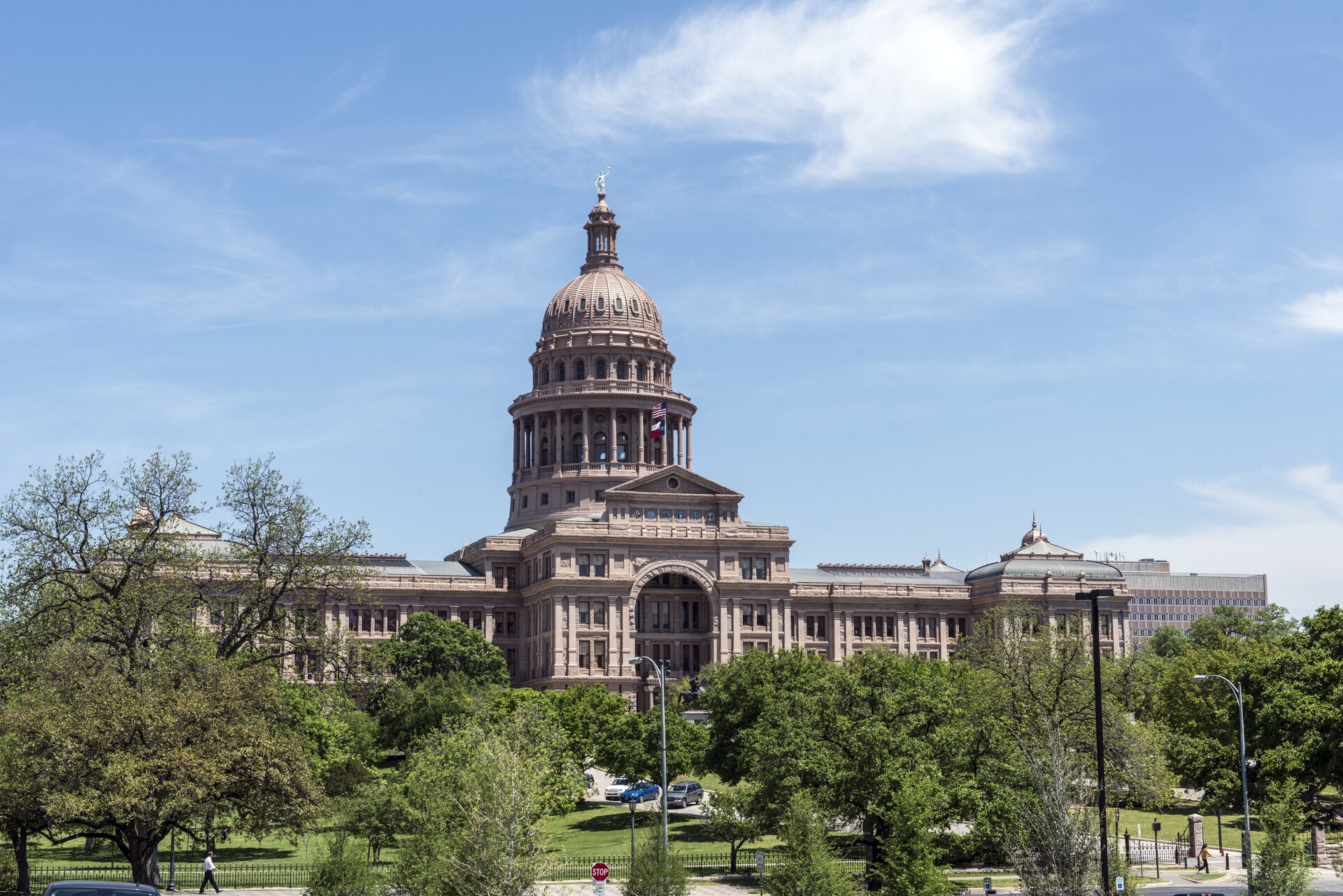
The Texas Capitol in Austin. Photo: Carol M. Highsmith Archive, Library of Congress, via Wikimedia Commons, public domain.
Quick Answer: The Texas Cyber Command, the San Antonio agency created by House Bill 150 in 2025, is working with about $253.9 million across fiscal 2026 and 2027 and has asked the Legislature for $478.4 million for 2028-29, including $235.0 million in new items and 120 added positions. It reported 48 employees in May 2026 and must absorb every cybersecurity function of the Department of Information Resources by December 31, 2026.
Six weeks remain before the legal deadline for Texas to finish moving its state cybersecurity operations out of the Department of Information Resources (DIR) and into a stand-alone agency in San Antonio. As of November 18, 2026, the Texas Cyber Command has an appointed chief awaiting Senate confirmation, a first strategic plan and a first budget request on file. Together with DIR’s budget request and the Legislative Budget Board’s fiscal analysis, those documents show what the state is spending, how many people it has hired and what it expects in return.
What is the Texas Cyber Command and who runs it?
The command is a state agency established by House Bill 150 of the 89th Legislature and codified in Chapter 2063 of the Texas Government Code. Governor Greg Abbott, who had declared the proposal an emergency item, signed the bill on June 2, 2025, at the University of Texas at San Antonio (UTSA). The law took effect September 1, 2025. Its stated mission is to prevent and respond to cybersecurity incidents affecting state governmental entities and critical infrastructure.
The agency is led by a chief appointed by the governor and confirmed by the Senate. Abbott named retired Navy Vice Admiral Timothy “TJ” White as the first chief on September 16, 2025. According to the agency, White served 37 years in the Navy and commanded U.S. Fleet Cyber Command and the Cyber National Mission Force. Route Fifty reported in March 2026 that White was looking to the 2027 legislative session for Senate confirmation.
| Key fact | Detail |
|---|---|
| Enabling law | House Bill 150, 89th Legislature; Government Code Chapter 2063 |
| Headquarters | 506 Dolorosa Street, San Antonio (UTSA San Pedro I building) |
| Chief | Vice Admiral (Ret.) Timothy “TJ” White, appointed September 16, 2025 |
| Became operational | March 2026 |
| Headcount | 48 full-time employees as of May 2026 |
| Funding, fiscal 2026-27 | $253.9 million estimated and budgeted, all General Revenue |
| Request, fiscal 2028-29 | $478.4 million |
| Transfer deadline | December 31, 2026 |
What does the command actually do?
The statute assigns the agency a Cybersecurity Threat Intelligence Center, the Texas Information Sharing and Analysis Organization and a Unified Cyber Task Force that contains a Network Security Operations Center, a Cybersecurity Incident Response Unit and a Digital Forensics Laboratory. The agency’s website lists the threat intelligence center, the information-sharing organization and the forensics laboratory as still being stood up.
The command also now receives every cybersecurity incident report from state agencies and covered entities, and it certifies the annual security training that government employees and contractors must complete. Its fiscal 2027 list contains 86 certified programs.
How much money does the Texas Cyber Command have?
The headline figure used at the bill signing was $135 million, and DIR’s budget request shows a fiscal 2026 rider appropriation for the command of $135,536,236. The Legislative Budget Board’s fiscal note on the final bill, dated May 28, 2025, had estimated a General Revenue cost of $138.7 million through August 31, 2027.
The command’s own Legislative Appropriations Request, filed in August 2026, shows a larger operating base once money that followed the transferred DIR programs is counted. It lists $131,492,228 estimated for fiscal 2026 and $122,433,128 budgeted for fiscal 2027, a two-year total of $253,925,356. Nearly all of it arrived as transfers from DIR: $222.4 million in fiscal 2026 and $28.6 million in fiscal 2027.
For comparison, a Legislative Budget Board issue brief published in November 2024 put DIR’s security funding in the 2024-25 budget at $102.7 million in All Funds, including $24.8 million for regional security operations centers and $22.2 million for endpoint detection and response. On those figures, the state’s dedicated cybersecurity budget is roughly two and a half times its level one budget cycle earlier, although the two totals are not built on identical program lists.
How much is the command asking for in 2028-29?
The request totals $478,381,971 for the two years, 88% more than the current biennium’s operating total. The base request of $243.4 million is about 4% below current funding. The increase comes entirely from seven exceptional items worth $234,984,376.
| Exceptional item | 2028-29 request | What it funds |
|---|---|---|
| Shared cyber protection | $65.6 million | Identity security, protective DNS, cloud protection and $31 million for regional center delivery and expansion |
| Cost recovery | $54.4 million | Sustaining services transferred from DIR |
| AI and quantum risk | $41.5 million | AI model access, AI system security, cryptographic discovery |
| Statutory staffing | $29.1 million | 120 full-time positions |
| Threat warning for critical infrastructure | $18.3 million | Sensors, analysis tools, threat data, analyst training |
| Incident intake and recovery | $13.6 million | Common incident portal and hotline technology |
| Information-sharing modernization | $12.4 million | Statewide system of record for risk and member onboarding |
| Total | $235.0 million | All General Revenue |
Only one of the seven items adds state employees. The rest buy technology and contracted services, in line with the Legislative Budget Board’s 2025 assumption that the command would rely heavily on contracted personnel. The capital schedule also lists $5 million in fiscal 2027 to renovate the UTSA San Pedro I building. DIR, for its part, requested no money for its two former cybersecurity strategies in 2028-29 and submitted no exceptional items, according to its request and Industry Insider Texas.
How many people work at the Texas Cyber Command?
Fewer than the Legislature’s analysts projected. The fiscal note assumed 65 positions in fiscal 2026 and 130 from fiscal 2027 onward. The command’s strategic plan, submitted to the Legislature on June 1, 2026, reported a headcount of 48 as of May 2026: 32 employees who came from DIR and 16 hired directly.
| Source and date | Staffing figure |
|---|---|
| LBB fiscal note, May 2025 | 65 positions in fiscal 2026; 130 in fiscal 2027 and after |
| DIR appropriations request, August 2026 | 46 cybersecurity positions transferred to the command on March 1 |
| Command strategic plan, May 2026 | 48 employees; goal of 122 by the end of fiscal 2027; full need about 180 |
| Command appropriations request, August 2026 | 61.0 positions in fiscal 2026; 92.0 in fiscal 2027; 212.0 in 2028-29 if the staffing item is funded |
The documents do not line up exactly. DIR counts 46 transferred positions while the command counts 32 transferred employees, a gap consistent with positions moving without the people who held them, though neither agency explains it. The direction is consistent: the agency estimates it needs about 180 people for around-the-clock operations and had roughly a quarter of that in May.
The strategic plan reports that 26% of employees (12 people) qualify for the state’s military employment preference, above the 20% state goal. It identifies shortages in threat intelligence, cloud security, incident response and security engineering, and acknowledges that state pay can trail private-sector rates.
What incident data does Texas publish?
Very little in aggregate. None of the DIR or Cyber Command documents reviewed for this article gives a statewide count of reported incidents, and the 2026 list of prioritized agency cybersecurity projects is marked confidential under state law. What the public record does show is the reporting framework and a handful of named cases.
State agencies, universities, local governments, school districts and charter schools must report a confirmed or suspected incident within 48 hours of discovery and file a follow-up analysis within 10 business days of recovery. Local reporting dates to Senate Bill 271 of 2023.
The command’s budget request cites three recent cases: a 2024 compromise of industrial controls at a water utility in Muleshoe, a 2024 ransomware attack on UT Health East Texas that exposed data on more than 15,000 Texans, and a June 2026 vendor breach affecting more than three million Texas Parks and Wildlife license holders. The origin story is older. An August 2019 ransomware attack hit 23 local governments at once and led to the first regional security operations center at Angelo State University. A DIR award submission to the National Association of State Chief Information Officers states that 90% of known incidents occur at the local level.
What results has the command promised?
The appropriations request sets measurable targets for the first time. The key measure is the average time from compromise to detection and mitigation, for which the request lists targets of 1,080 minutes (18 hours) in fiscal 2028 and 720 minutes (12 hours) in fiscal 2029.
| Performance measure | FY 2027 | FY 2028 | FY 2029 |
|---|---|---|---|
| Entities with regional center service agreements | 700 | 720 | 745 |
| Entities receiving continuous diagnostics and mitigation | 290 | 325 | 345 |
| Penetration tests completed | 50 | 50 | 50 |
| Cyber defense and tabletop exercises | 4 | 6 | 8 |
One inherited baseline is weak: DIR’s request shows agencies’ security maturity over repeat assessments declined 8.7% in fiscal 2025 against a 3% improvement target for 2026 and 2027.
How large is the Texas cybersecurity workforce?
The command’s strategic plan, citing the CyberSeek workforce data tool, says Texas had more than 103,000 cybersecurity workers and nearly 40,000 unfilled cybersecurity jobs in 2025. Nationally, CyberSeek counted nearly 500,000 cybersecurity job postings in the 12 months from the second quarter of 2024 through the first quarter of 2025.
The U.S. Bureau of Labor Statistics reports that information security analysts earned a median $129,180 in May 2025 and held 192,900 jobs nationwide in 2025. It projects 21% growth, or 40,600 additional jobs, from 2025 to 2035.
Why San Antonio?
The command’s listed partners explain the choice: UTSA, the National Security Agency, the Sixteenth Air Force at Joint Base San Antonio, U.S. Army Cyber Command and the FBI, among others. UTSA says it produces more bachelor’s graduates in cybersecurity than any other state university.
The regional centers double as a training pipeline. As of May 2025, DIR counted 63 student analysts at Angelo State, 31 at the University of Texas at Austin and 23 at the University of Texas Rio Grande Valley, 117 in all, serving 65 counties.
What has the command done publicly so far?
Its most visible project is Project Watershed 250, a federal pilot launched in San Antonio on August 31, 2026, by the governor and White House National Cyber Director Sean Cairncross. Texas is the first state selected. The pilot, which Industry Insider Texas described as lasting six months, offers water and wastewater utilities cyber assessments, remediation help and defensive tools at no cost. The command says Texans rely on more than 7,400 public water systems and more than 3,000 wastewater treatment facilities. On November 17, 2026, it announced that 63 technology and cybersecurity companies had joined.
What should Texas businesses watch next?
- December 31, 2026: the statutory deadline for all DIR cybersecurity functions to complete their move.
- The 2027 legislative session: lawmakers will decide how much of the $235.0 million in exceptional items to fund and whether to confirm the chief.
- Hiring: the gap between 48 employees in May 2026 and a goal of 122 by August 2027 is the most concrete test of execution.
- Contract demand: six of seven exceptional items add no state employees and fund technology and services, a direct signal for security vendors and integrators that sell to the state.
Frequently Asked Questions
When was the Texas Cyber Command created?
Governor Greg Abbott signed House Bill 150 on June 2, 2025, and the law took effect September 1, 2025. The agency says it became operational in March 2026.
Who leads the Texas Cyber Command?
Retired Navy Vice Admiral Timothy “TJ” White, appointed by the governor on September 16, 2025. The position requires Senate confirmation.
How much funding does the Texas Cyber Command have?
Its appropriations request shows $131.5 million estimated for fiscal 2026 and $122.4 million budgeted for fiscal 2027, about $253.9 million in General Revenue. It has requested $478.4 million for 2028-29.
How many employees does it have?
The agency reported 48 full-time employees as of May 2026, plans to reach 122 by the end of fiscal 2027 and estimates its full requirement at about 180.
How quickly must Texas governments report a cyberattack?
Within 48 hours of discovery, with a follow-up analysis due within 10 business days after recovery. Reports now go to the Texas Cyber Command.
Sources and Further Reading
- Legislative Appropriations Request, Fiscal Years 2028-2029, Texas Cyber Command
- Agency Strategic Plan, Fiscal Years 2027-2031, Texas Cyber Command
- Annual Financial Report, Fiscal Year 2026, Texas Cyber Command
- About the Agency, Report an Incident and Resources pages, Texas Cyber Command
- Project Watershed 250 press releases, September 1 and November 17, 2026, Texas Cyber Command
- Fiscal Note, House Bill 150, 89th Legislature, May 28, 2025, Legislative Budget Board
- Legislative Appropriations Request, Fiscal Years 2028-2029, Texas Department of Information Resources
- Department of Information Resources Cybersecurity issue brief, November 2024, Legislative Budget Board
- Governor Abbott, National Cyber Director Launch Project Watershed 250, August 31, 2026, Office of the Texas Governor
- Abbott Signs Texas Cyber Command Into Law, June 3, 2025, UTSA Today
- The Texas Regional Security Operations Centers 2.0 award submission, National Association of State Chief Information Officers
- Information Security Analysts, Occupational Outlook Handbook, U.S. Bureau of Labor Statistics
- CyberSeek 2025 infographic, CyberSeek
- Texas Cyber Command LAR Seeks $235M in Exceptional Items; DIR LAR Shows Shift From Cybersecurity Expansion to AI; Texas Cyber Command Joins Federal Water Sector Cybersecurity Pilot, Industry Insider Texas
- New Texas Cyber Command Looks to Bind the State Together, March 16, 2026, Route Fifty