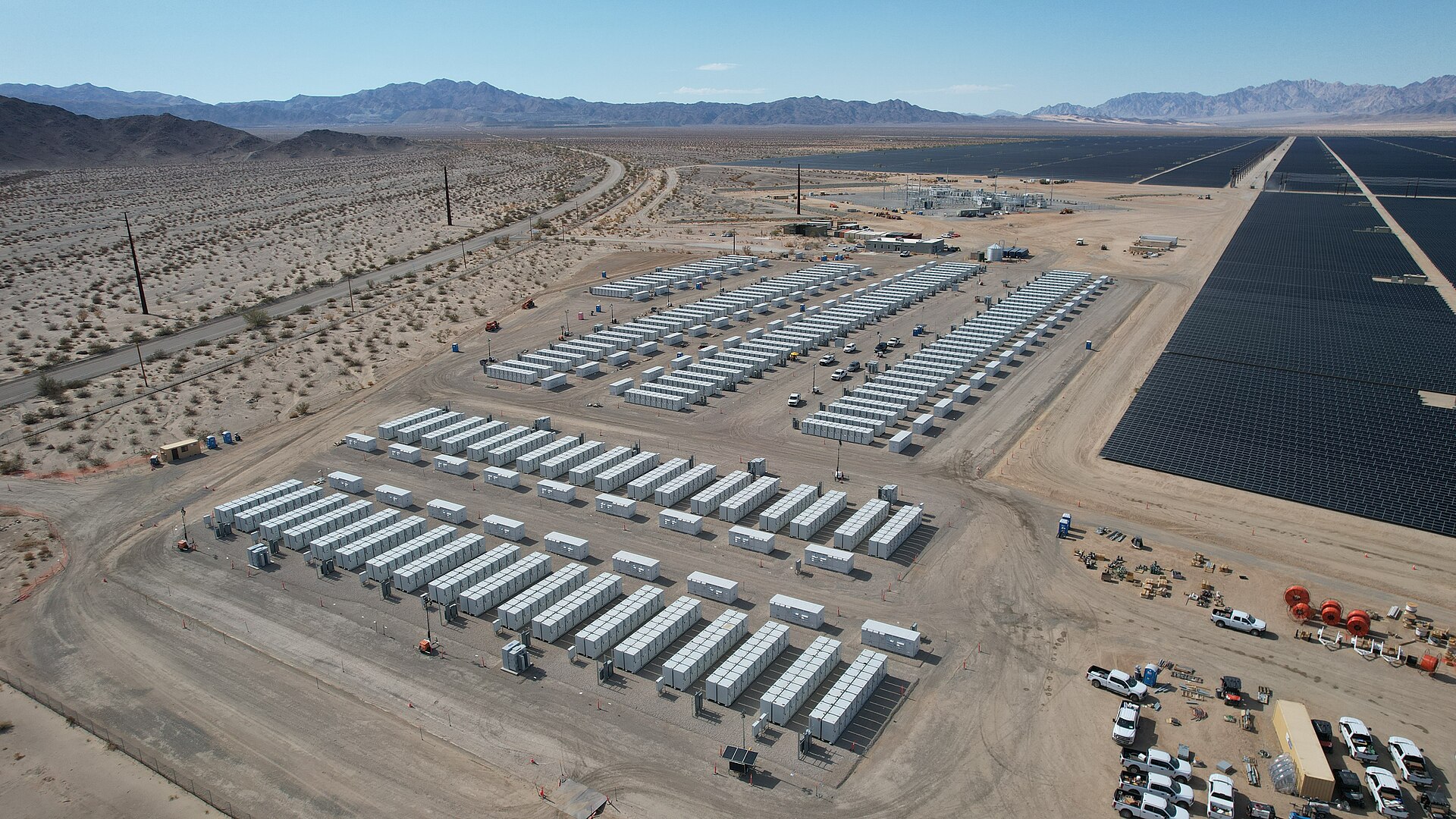
A grid-scale battery energy storage system of the type being built across Texas (pictured: Desert Sunlight, California, 2023). Photo: U.S. Bureau of Land Management via Wikimedia Commons (public domain).
Quick Answer: The ERCOT grid had about 18.7 gigawatts (GW) and 33.4 gigawatt-hours (GWh) of commercially operating battery storage at the end of September 2026, according to Modo Energy, up from roughly 857 megawatts in 2021. Batteries discharged a record of nearly 12 GW on July 22, 2026, the evening Texas set an all-time demand record of 91,134 megawatts (MW). Growth is now leveling off at about 6 GW a year as the development pipeline thins.
How much battery storage does Texas have on the ERCOT grid?
As of November 17, 2026, the most recent published counts put the Texas battery fleet between roughly 18 GW and 21 GW, depending on whether units still in commissioning are included.
Market tracker Modo Energy counted 18.7 GW and 33.4 GWh of commercially operational battery energy storage in the Electric Reliability Council of Texas (ERCOT) region at the end of the third quarter of 2026. That works out to an average duration of about 1.8 hours at full output.
ERCOT’s own Monthly Outlook for Resource Adequacy (MORA) for December 2026, published in early October, uses a wider definition. It lists about 21.1 GW of installed energy storage. About 3.3 GW of that is synchronized to the grid but not yet approved for commercial operations.
A September 2026 report by GCN put the fleet at about 857 MW in 2021. A presentation on battery storage posted with ERCOT board materials and dated February 9, 2026 put installed and operating capacity at 15,712 MW, with about 30% of the fleet co-located with solar farms.
Key facts: Texas grid battery storage
| Measure | Figure | Period and source |
|---|---|---|
| Commercially operating batteries | 18.7 GW / 33.4 GWh | End of September 2026, Modo Energy |
| Installed storage incl. units in commissioning | About 21.1 GW | December 2026 MORA, ERCOT |
| Record battery discharge | 11,980 MW | July 22, 2026, Grid Status |
| All-time ERCOT demand record | 91,134 MW | July 22, 2026, ERCOT |
| Battery requests in interconnection queue | About 164 GW | August 2026, ERCOT |
How much battery capacity was added in 2025 and 2026?
Texas added about 6 GW of batteries in 2025 and is on pace to add a similar amount in 2026. Modo Energy’s second-quarter report said year-over-year fleet growth ran near 100% through 2024, slowed to 76% in 2025 and was tracking toward about 40% in 2026.
The quarterly record still fell this year. Developers brought 2.2 GW and 4.6 GWh into commercial operation in the third quarter of 2026, from 20 units at 18 sites, edging past the 2.05 GW added in the third quarter of 2025. The Houston load zone took 1.22 GW, or 57% of the quarter’s additions.
| Period | Capacity added | Fleet at period end |
|---|---|---|
| Full year 2025 | About 6.05 GW | Not stated in reports reviewed |
| Q1 2026 | 1.1 GW (20 projects) | 14.96 GW / 24.6 GWh |
| Q2 2026 | About 1.5 GW (20 projects) | 16.5 GW / 28.8 GWh |
| Q3 2026 | 2.2 GW / 4.6 GWh (20 units) | 18.7 GW / 33.4 GWh |
Source: Modo Energy quarterly reports. Quarterly figures are rounded.
New batteries are also running longer. Units added in the third quarter averaged 2.1 hours, and Modo Energy reported that the first systems of four hours or more arrived in the second quarter. The February board presentation noted that the evening drop in solar output lasts two to four hours.
How did batteries perform during the summer 2026 peaks?
Texas got through a record-setting summer with no emergency conditions reported, and batteries carried much of the evening load. ERCOT’s Summer 2026 Operational and Market Review recorded a new all-time demand record of 91,134 MW on July 22, 2026, in the hour ending 7 p.m. The U.S. Energy Information Administration (EIA) put the peak 6% above the 85.5 GW record set on August 10, 2023, and reported that natural gas supplied 48% of generation and solar 32% at the peak.
Grid Status, which tracks ERCOT data, reported that battery discharge reached a record 11,980 MW on July 22. That compares with an earlier record of just over 8 GW set in October 2025, according to the February board presentation. Grid Status also reported a net load record that evening, 75,733 MW at about 8 p.m. Net load is demand minus wind and solar output, the amount gas plants and batteries must cover.
Solar set its own record a day earlier, 34,665 MW on July 21. ERCOT’s August peak, 90,817 MW on August 24, was 7,110 MW above the prior August record.
Did batteries hold down wholesale power prices?
The price record suggests so. Grid Status reported that real-time prices on July 22 peaked at $378 per megawatt-hour. On August 20, 2024, the date of an earlier demand peak with far less storage on the system, real-time prices hit the $5,000 market cap. Evening battery discharge on July 22 was about 8 GW higher than on that 2024 date.
ERCOT’s summer review found that real-time hub prices were lower in summer 2026 than in 2024 or 2025, and that storage resources dominate ancillary service awards.
What limits did the summer expose?
Batteries run out. ERCOT’s review described evening state-of-charge exhaustion as a recurring pattern in summer 2026. Fleet state of charge fell below 20% in 15% of hours and below 10% in 0.74% of hours. On the three lowest days, the fleet bottomed out at 9.05%, 6.20% and 8.23% of its energy capacity, compared with 15.63%, 16.17% and 12.81% on the three lowest days of 2025.
The hour of tightest supply has also moved later. ERCOT said the peak net load hour shifted from the hour ending 9 p.m. to the hour ending 10 p.m. in June and July.
Winter is a different problem. For December 2026, ERCOT expects the riskiest hour to be the one ending 8 a.m., when solar output is close to zero. Of about 21.1 GW of installed storage, the grid operator counts on about 9.1 GW being available in that hour, against a forecast peak load of 75,148 MW.
Who is building Texas battery projects?
The developer base is broad. In the third quarter of 2026, Modo Energy ranked Lydian Energy first by additions, with 564 MW across its Headcamp, Pintail Pass and Soda Lake 1 sites. Greenflash added 409 MW at Sahara and Sahara 2. Orsted (Buffalo Creek), Cypress Creek (Rhapsody) and Alpha Omega Power (Vertus) each brought on sites of more than 200 MW.
Earlier in the year, the largest site to reach commercial operation in the first quarter was Platinum, a 310 MW two-unit project in Fannin County owned and operated by ENGIE. Aypa Power’s 208 MW Bypass and Tesla’s 125 MW TE Smith followed.
Larger projects are on the way. EIA’s February 2026 outlook listed three Texas sites among the four biggest U.S. battery projects planned for the year: Lunis Creek in Jackson County at 621 MW, Clear Fork Creek in Wilson County at 600 MW, and the 418 MW storage portion of Tehuacana Creek 1 in Navarro County, which is paired with 837 MW of solar.
How big is the pipeline, and is the boom slowing?
EIA said in February that developers planned 24 GW of battery additions nationwide in 2026, compared with a record 15 GW in 2025, and that Texas accounted for 12.9 GW, or 53%, of the planned total.
Actual Texas completions are running at about half the planned figure. Modo Energy counted 4.7 GW in commercial operation through September, against 4.2 GW at the same point in 2025, and estimated the year would end near 6.2 GW.
ERCOT’s August 2026 operations report showed about 164 GW of battery requests in the interconnection queue, more than solar at 156 GW, gas at 82 GW or wind at 48 GW. Modo Energy reported that new queue entries fell to about 14 GW per half-year from a peak of 31 GW in the first half of 2025, and that a record 13.7 GW withdrew in the first half of 2026.
The firm traced the slowdown to revenue. Battery revenues averaged about $29 per kilowatt-year through the first five months of 2026, and the median time from queue entry to operation has risen from 2.3 years in 2021 to 4.4 years. Projects with an interconnection agreement and posted financial security total 5.9 GW for 2027, and Modo Energy expects 3.7 GW to 4.8 GW to be completed that year.
What state policy affects battery storage in Texas?
Texas regulates how batteries are sited and retired, but its main power-plant subsidy has gone to natural gas. The Texas Energy Fund, administered by the Public Utility Commission of Texas, offers low-interest loans and completion bonus grants for new dispatchable generation of at least 100 MW in ERCOT. POWER Magazine reported that the loans run 20 years at 3% interest and cover up to 60% of project cost.
As of October 30, 2025, five loans worth $2.3 billion had been finalized for 3,109 MW. On October 7, 2026, the governor announced the ninth loan, for a 452 MW plant in Reeves County, and the eight earlier projects totaled 4,994 MW. Every project named in the loan announcements reviewed for this article is a natural gas plant; none is a battery.
Two 2025 laws apply directly to storage. House Bill 3809, signed May 29, 2025 and effective September 1, 2025, requires leases for non-utility battery sites to commit the operator to remove equipment and to post financial assurance for cleanup no later than the 15th year of operation. House Bill 3824 set fire safety standards and testing requirements for battery projects.
A further-reaching bill died in a House committee in 2025. Senate Bill 388 would have required half of new ERCOT generation to be dispatchable and would not have counted batteries toward that share. Separately, ERCOT changed its market design on December 5, 2025, when real-time co-optimization plus batteries took effect. Each battery’s state of charge is now part of the grid operator’s dispatch calculation.
Brian’s Take
The number that stands out to me is not the 18.7 GW. It is the price. On a night when Texas demand set an all-time record, real-time power peaked at $378 per megawatt-hour. Two summers earlier, a lower peak sent prices to the $5,000 cap. That gap is the clearest evidence in this data that storage has changed how the Texas grid behaves under stress.
But the same result is the industry’s problem. Batteries in Texas earn their living from price spikes, and they have been very good at erasing them. Revenue near $29 per kilowatt-year, a record 13.7 GW of queue withdrawals in six months and a 2027 pipeline well below this year’s pace all point the same way. I read that as a market working roughly as designed, though the days of doubling every year appear to be over.
What I would watch is duration and the evening hours. ERCOT’s own review shows the fleet draining to single-digit state of charge on the hardest days, and the tight hour sliding toward 10 p.m. Whether four-hour systems pencil out without any state support, while the Texas Energy Fund backs gas, is the open question in these numbers.
Frequently Asked Questions
How many gigawatts of battery storage does ERCOT have?
About 18.7 GW and 33.4 GWh were in commercial operation at the end of September 2026, according to Modo Energy. ERCOT’s December 2026 resource adequacy outlook lists about 21.1 GW installed when units still in commissioning are counted.
What is the ERCOT battery discharge record?
Grid Status reported a record of 11,980 MW on the evening of July 22, 2026, the same day ERCOT set its all-time demand record of 91,134 MW.
Does the Texas Energy Fund pay for batteries?
The fund’s loan and completion bonus programs are for dispatchable generation of at least 100 MW. All nine loans announced through October 7, 2026 that were reviewed for this article went to natural gas plants.
Is battery growth in Texas slowing?
Annual additions have flattened at about 6 GW in both 2025 and 2026. Queue withdrawals reached a record 13.7 GW in the first half of 2026, and Modo Energy expects 3.7 GW to 4.8 GW of additions in 2027.
Sources and Further Reading
- New U.S. electric generating capacity expected to reach a record high in 2026, U.S. Energy Information Administration, Today in Energy (February 20, 2026)
- Hourly peak load in ERCOT set a new record, exceeding 91 GW on July 22, U.S. Energy Information Administration, Today in Energy (August 3, 2026)
- Summer 2026 Operational and Market Review, Electric Reliability Council of Texas
- Monthly Outlook for Resource Adequacy, December 2026, Electric Reliability Council of Texas
- Monthly Operational Overview, August 2026, Electric Reliability Council of Texas
- Understanding Battery Energy Storage Systems: Current and Future, ERCOT board meeting materials (February 9, 2026)
- ERCOT BESS buildout reports for Q1, Q2 and Q3 2026, Modo Energy
- Another Record Bites the Dust, Grid Status (August 3, 2026)
- Report on the Texas battery fleet and the July 22 demand peak, GCN (September 8, 2026)
- The Texas Energy Fund program page, Public Utility Commission of Texas
- Texas Issues First Performance-Based Grant Under Energy Fund, POWER Magazine (November 13, 2025)
- Gov. Abbott Announces Texas Energy Fund Loan for 452 MW West Texas Power Plant, San Angelo LIVE (October 7, 2026)
- Texas Adopts New Decommissioning Law for Battery Energy Storage Systems, Baker Botts (July 2025)
- Bills’ Defeat Means Brighter Outlook for Texas Renewables, Troutman (July 10, 2025)