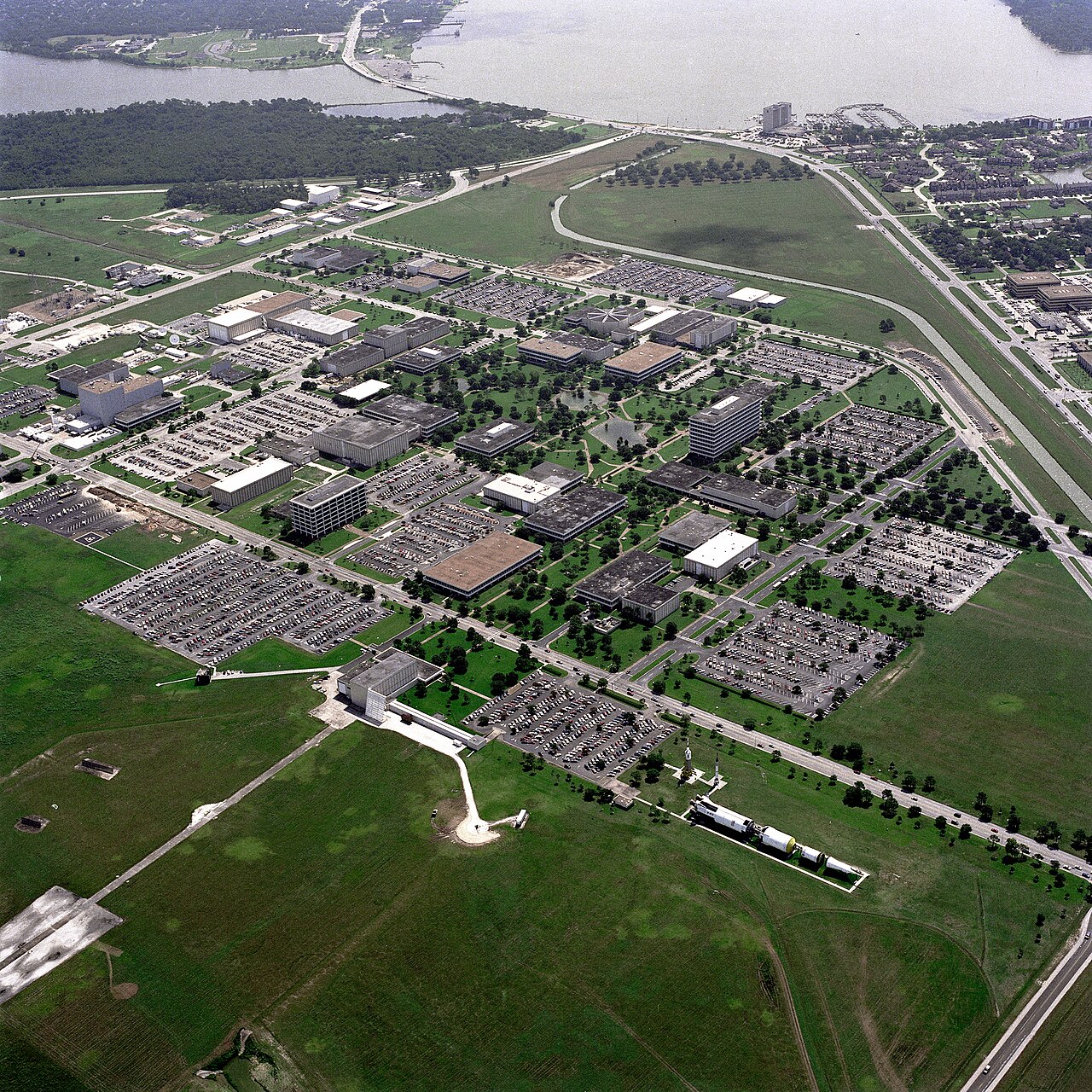
Aerial view of NASA Johnson Space Center, Houston. Photo: NASA via Wikimedia Commons. Public domain.
Quick Answer
As of November 15, 2026, the Texas Space Commission has committed every dollar of its first $150 million appropriation to 24 projects, and it has not yet awarded any of the additional $300 million the Legislature approved in 2025. The commission’s board spent 2026 issuing information requests, weighing set-asides and discussing a possible state incentive of as much as $100 million for the proposed U.S. Space Academy, with state proposals due to NASA on November 16, 2026. Meanwhile, three grant recipients with Texas operations, SpaceX, Firefly Aerospace and Intuitive Machines, reported sharply higher revenue or raised record capital this year.
How much money has Texas put into its space fund?
The Texas Legislature created the Texas Space Commission in 2023 through House Bill 3447 and gave it a grant vehicle called the Space Exploration and Aeronautics Research Fund, known as SEARF. According to the commission’s own releases, total legislative appropriations to the SEARF Trust now stand at $450 million: $150 million from the 2023 session and $300 million approved in 2025.
The first tranche is gone. On February 17, 2026, the board conditionally approved $14,154,767 for Rice University. The commission said that award, together with $705,000 for the Texas Aerospace Research and Space Economy Consortium (TARSEC), fully committed the 2023 appropriation. The commission’s awards page lists 24 grants. Adding the listed ceilings produces about $149.3 million, and the TARSEC funding brings the figure to $150 million.
Two details matter for anyone reading those totals. First, every award is listed as an “up to” amount. Second, the commission states that funding is paid as reimbursement, only after a grant agreement is executed and agreed deliverables are met. The award figures are therefore ceilings, not checks already written. This article found no public figure for how much has actually been reimbursed.
What are the key facts as of November 2026?
| Item | Figure | Date or period |
|---|---|---|
| Total appropriations to the SEARF Trust | $450 million | 2023 and 2025 legislative sessions |
| Committed from the 2023 appropriation | $150 million, 24 projects | January 24, 2025 to February 17, 2026 |
| New appropriation not yet awarded | $300 million | Approved 2025; no awards announced as of November 15, 2026 |
| Largest single award | $19,758,376, Borderplex Alliance, El Paso | Approved December 19, 2025 |
| Air Force Research Laboratory partnership agreement | Up to $300 million in federal funding, ending 2036 | Announced August 2026 |
| Texas space industry jobs | About 7,000 | Dallas Fed analysis, published April 1, 2026 |
| Texas aerospace and defense jobs | About 170,000 | Dallas Fed analysis, published April 1, 2026 |
Who received the first $150 million?
The 24 awards went to 15 companies, two universities and seven local governments, councils of governments or nonprofit groups. By this article’s tally of the commission’s published list, companies received about $94.4 million, the two universities about $23.4 million, and public and nonprofit recipients about $31.4 million. Recipients with Houston addresses account for eight awards worth about $67.9 million, roughly 45 percent of the fund.
The table below covers the awards of $7 million or more. Dates are the board approval dates shown on the commission’s awards page; project descriptions come from the commission’s individual grant releases where those were reviewed.
| Recipient | Location | Up to | Approved | Project |
|---|---|---|---|---|
| The Borderplex Alliance | El Paso | $19,758,376 | 12/19/2025 | El Paso Space Innovation Hub, including a secure facility and space for U.S. Space Force personnel |
| Starlab Space | Houston | $15,000,000 | 2/10/2025 | System Integration Lab and Payload Integration Lab for a planned commercial station |
| Rice University | Houston | $14,154,767 | 2/17/2026 | Center for Space Technologies focused on lunar resource use |
| Intuitive Machines | Houston | $10,000,000 | 2/10/2025 | Zephyr Orbital FabLab, a commercial orbital return vehicle |
| Aegis Aerospace | Houston | $10,000,000 | 4/16/2025 | Description not reviewed |
| CesiumAstro | Austin | $10,000,000 | 5/22/2025 | Description not reviewed |
| University of Texas at Austin | Austin | $9,270,000 | 12/19/2025 | Space domain awareness lab |
| Firefly Aerospace | Cedar Park | $8,200,000 | 2/10/2025 | Central Texas Spacecraft Development Center |
| SpaceX | Brownsville | $7,500,000 | 2/10/2025 | Foundation for the Gigabay Starship facility at Starbase |
| Blue Origin | Van Horn | $7,000,000 | 2/10/2025 | Subcooling upgrades to an engine test stand for BE-4 testing |
The remaining 14 awards, each under $7 million, went to KULR Technology Group, Axiom Space, the City of Midland, the Aldrin Family Foundation of Texas, Interlune, ILC Astrospace, Venus Aerospace, El Paso County, ICON Technology, the Concho Valley Council of Governments, the South Plains Association of Governments, FluxWorks, SylLab Systems and the West Central Texas Council of Governments.
What did the best-known space companies commit to build?
The projects are concrete. SpaceX’s grant pays for the foundation of its Gigabay facility at Starbase, which the commission says adds 24 work cells for building, integrating and refurbishing Starship vehicles. Blue Origin’s grant adds liquid nitrogen storage and related upgrades to an engine test stand at its Van Horn site. Firefly’s grant backs a facility for producing and integrating orbital vehicles and lunar landers.
The grant agreements also carry end dates. Per the commission’s releases, SpaceX’s grant had a termination date of December 31, 2025, Starlab’s May 31, 2026, Intuitive Machines’ June 30, 2026 and Blue Origin’s September 30, 2026. Firefly’s runs to July 31, 2027, Axiom’s to November 30, 2027 and Borderplex’s to January 31, 2029.
What happens to the next $300 million?
As of November 15, 2026, the commission’s newsroom shows no grant approved from the 2025 appropriation. The board has instead been gathering information before opening new competitions.
- June 30, 2026: The board approved seven resolutions. One authorizes a request for proposals to study the viability of Texas sites for launch and re-entry. One authorizes a competitive grant opportunity to match federal small business research awards. Five authorize requests for information on thermal vacuum test chambers, vibroacoustic testing, national security space infrastructure, life support systems and a shared-user propulsion test facility.
- September 23, 2026: The board adopted two more resolutions to issue requests for information, one on low-Earth orbit infrastructure and one on workforce development. It also discussed administratively setting aside part of the available trust money for two purposes: a major NASA or U.S. defense facility in Texas, and capabilities for low-Earth orbit systems made or operated in Texas. The release gave no dollar amount.
- November 9, 2026: The executive director issued a policy memo tightening direct awards. Requests under the deadline-based exception are accepted only during an active competitive grant period, and unsolicited emergency proposals are returned without evaluation.
- December 11, 2026: The board’s final 2026 meeting is scheduled in San Antonio.
Why does the U.S. Space Academy bid matter for the fund?
Texas Public Radio reported on October 20, 2026, that board members at the September 23 meeting discussed putting up as much as $100 million in state money to help Texas win the proposed U.S. Space Academy. The discussion was non-binding, no official action was taken, and the figure could change. According to that report, the academy was announced by executive order at Johnson Space Center on August 28, 2026; NASA allows one submission per state; proposals are due November 16; and a presidential commission is to make a recommendation by December 26. Florida, Ohio, West Virginia, Arizona, Alabama and Louisiana have also said they are pursuing it. Governor Greg Abbott named a bid team chaired by state Rep. Greg Bonnen on September 15, 2026.
What federal money has the commission attracted?
Two federal agreements arrived in August 2026. The Air Force Research Laboratory awarded the commission a Partnership Intermediary Agreement, called the Texas Space Defense Alliance, described as a federally funded contract worth up to $300 million with a 2036 termination date. NASA also named the commission one of seven state hubs for a skilled technical workforce program; the seven awardees share $10.5 million over a three-year effort.
How are the grant recipients performing as businesses?
Three recipients are now public companies, which makes their progress measurable.
| Company | Texas base | Latest verified figures | Period |
|---|---|---|---|
| Intuitive Machines | Houston | Revenue $269.3 million versus $52.4 million a year earlier; net loss $3.4 million; backlog $1.87 billion; cash $463.8 million; full-year revenue outlook $920 million to $950 million | Quarter ended September 30, 2026; reported November 12, 2026 |
| Firefly Aerospace | Cedar Park | Revenue $110.7 million, up 259 percent; net loss $94.2 million; backlog $1.7 billion; cash $409.3 million; full-year revenue outlook $440 million to $450 million | Quarter ended September 30, 2026; reported November 10, 2026 |
| SpaceX | Starbase | Fiscal 2025 revenue $18.7 billion, per Fortune’s account of its prospectus; initial public offering raised about $75 billion at $135 per share | Prospectus disclosed May 20, 2026; trading began June 12, 2026 |
Firefly tied its results directly to the state grant. In its November 10 release, the company said its Texas spacecraft cleanroom expansion is complete and operating, was funded by a non-dilutive Texas Space Commission grant, and supports assembly of up to 12 lunar landers and orbital vehicles at once. Intuitive Machines’ backlog includes $612.8 million acquired with Lanteris in January 2026.
Axiom Space, still private, moved its legal domicile to Texas, an action the Governor’s office announced on June 23, 2026. That release put annual economic output from NASA’s Johnson Space Center at more than $9.8 billion.
How many Texans work in the space industry?
It depends on the definition. A Federal Reserve Bank of Dallas analysis published April 1, 2026, counted about 7,000 jobs in the narrowly defined space industry in Texas, up 65 percent since 1990, with NASA accounting for about 40 percent of them. The broader aerospace and defense sector employs about 170,000 Texans across 2,270 establishments.
What is the status of the Texas A&M Space Institute?
The $200 million, 400,000-square-foot institute is the first building in Exploration Park, a 240-acre commercial property next to Johnson Space Center. Ground was broken in November 2024. Community Impact reported on March 2, 2026, that university documents listed an October 2026 opening and that Venturi Astrolab and Intuitive Machines had signed leases. This article could not confirm from a primary source that the building has opened.
Brian’s Take
I spent years as an investment manager and analyst, and the number I would watch here is not the $150 million. It is the gap between “awarded” and “reimbursed.” Every one of these grants is a ceiling that pays out only after deliverables are met. That is a sensible structure for taxpayers, but it also means the headline total tells you what Texas promised, not what Texas has paid.
What strikes me is the mismatch in scale. The state’s largest award to a company was $15 million. Firefly and Intuitive Machines each report backlog well above $1.5 billion, and SpaceX raised about $75 billion in one offering. State money is a rounding error on those balance sheets. Where it seems to count is in specific buildings and test stands sited in Texas, like the cleanroom Firefly says is now operating.
The harder question is the next $300 million. A year after the Legislature approved it, the board is still collecting information and discussing set-asides, including a possible $100 million for an academy the state has not won. I would rather see careful homework than rushed checks, but Texas business owners waiting on the next competition deserve a calendar.
Frequently Asked Questions
What is SEARF?
SEARF is the Space Exploration and Aeronautics Research Fund, the Texas Space Commission’s grant program. Businesses, nonprofits and governmental entities, including universities, are eligible. Awards are paid as reimbursement.
How much has the Texas Space Commission awarded?
It has committed $150 million to 24 projects, with approvals running from January 24, 2025, to February 17, 2026. That exhausts the 2023 appropriation.
Has any of the new $300 million been awarded?
No award from the 2025 appropriation had been announced as of November 15, 2026. The board has authorized information requests, a study and one matching-grant competition.
Which company received the largest SEARF grant?
Starlab Space received the largest company award, up to $15 million. The largest award overall, up to $19,758,376, went to the Borderplex Alliance in El Paso.
Did SpaceX and Blue Origin receive Texas grants?
Yes. SpaceX was approved for up to $7.5 million for its Starbase Gigabay foundation and Blue Origin for up to $7 million for engine test stand upgrades in Van Horn, both on February 10, 2025.
Sources and Further Reading
- SEARF Grant Awards and The Space Exploration and Aeronautics Research Fund, Texas Space Commission
- $14.1 million approved by Texas Space Commission for SEARF grant award, Texas Space Commission
- $9.3 million approved by Texas Space Commission for SEARF grant award, Texas Space Commission
- $47.7 million approved by Texas Space Commission for SEARF grant awards, Texas Space Commission
- Individual grant award releases for SpaceX, Blue Origin, Firefly Aerospace, Intuitive Machines, Starlab Space, Axiom Space, Borderplex and City of Midland, Texas Space Commission
- Texas Space Commission Board Outlines Next Steps to Grow the Space Economy in Texas, Texas Space Commission
- Texas Space Commission receives briefing from Space Foundation CEO and Adopts two Resolutions to issue RFIs, Texas Space Commission
- Direct Award Process Update Memo, November 2026, Texas Space Commission
- July 2026 newsletter, Texas Space Commission
- Partnership Intermediary Agreement and NASA State Hubs releases, Texas Space Commission
- Texas is lobbying for the new U.S. Space Academy, Texas Public Radio
- Intuitive Machines third quarter 2026 results, Form 8-K exhibit, U.S. Securities and Exchange Commission
- Firefly Aerospace Announces Third Quarter 2026 Financial Results, Firefly Aerospace
- Governor Abbott Announces Axiom Space Redomiciles In Texas, Office of the Texas Governor
- Region’s commercial space exploration industry has lofty goals for growth, discovery, Federal Reserve Bank of Dallas
- Texas A&M Space Institute on schedule to open in fall 2026, Community Impact
- SpaceX prospectus and initial public offering coverage, Fortune and NPR
- Two Texas A&M professors tapped to help bring U.S. Space Academy to Texas, KBTX