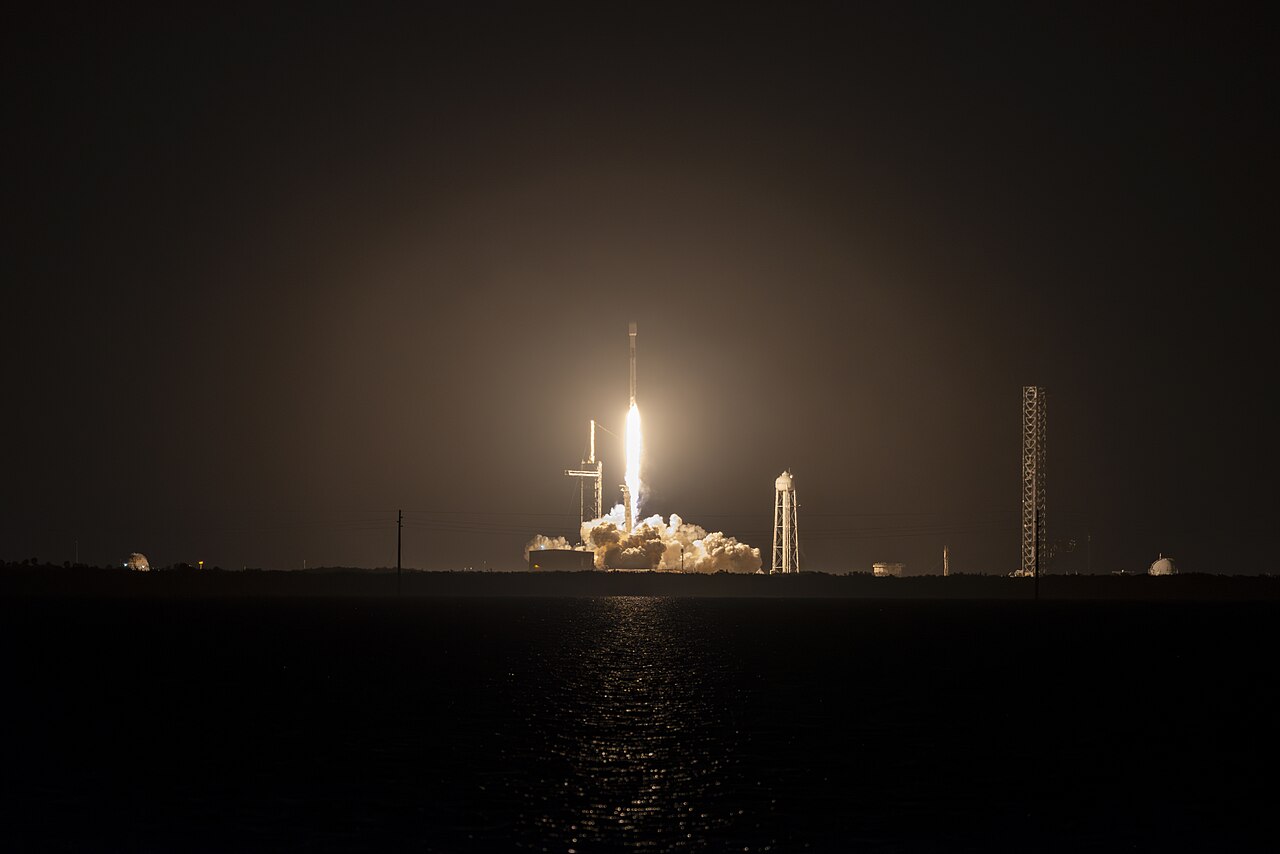
A Falcon 9 rocket carrying Firefly Aerospace's Blue Ghost lunar lander lifts off from Kennedy Space Center, Florida. U.S. Space Force photo by DeAnna Murano. Public domain (U.S. federal government work).
Quick Answer: Cedar Park-based Firefly Aerospace reported third-quarter 2026 revenue of $110.7 million, up 259% from a year earlier, and a record backlog of $1.7 billion. The company narrowed its full-year revenue guidance to $440 million to $450 million and disclosed contracts valued at more than $1.3 billion with AST SpaceMobile, while posting a net loss of $94.2 million.
Firefly Aerospace, the Central Texas rocket and spacecraft maker that trades on Nasdaq under the ticker FLY, released results on November 10, 2026 for the quarter ended September 30. The report shows a company growing quickly in government and spacecraft work while still spending far more than it earns. This article reviews the quarter using the company’s earnings release filed with the Securities and Exchange Commission and an analysis published by Earnings Whispers. Figures are as of those documents.
What did Firefly Aerospace report for the third quarter of 2026?
Revenue was $110.7 million, compared with $30.8 million in the third quarter of 2025. Cost of sales rose to $85.4 million from $22.3 million, leaving gross profit of $25.3 million, up from $8.5 million. Gross margin was 22.9%, down from 27.6% a year earlier.
Operating expenses grew faster than gross profit. Research and development spending was $76.0 million, up from $48.8 million, and selling, general and administrative expense more than doubled to $50.9 million from $21.9 million. Total operating expenses were $126.9 million, and the loss from operations widened to $101.6 million from $62.2 million.
The net loss narrowed to $94.2 million from $133.4 million, but the comparison is affected by two items in the prior-year quarter: a $42.2 million charge related to warrant liabilities and a $30.4 million loss on the extinguishment of debt. Net loss per share was $0.56, compared with $1.50, on a weighted average of 168.4 million shares, up from 93.8 million.
| Metric | Q3 2026 | Q3 2025 |
|---|---|---|
| Revenue | $110.7 million | $30.8 million |
| Gross profit | $25.3 million | $8.5 million |
| Gross margin | 22.9% | 27.6% |
| Research and development | $76.0 million | $48.8 million |
| Selling, general and administrative | $50.9 million | $21.9 million |
| Loss from operations | $101.6 million | $62.2 million |
| Net loss | $94.2 million | $133.4 million |
| Net loss per share | $0.56 | $1.50 |
How do the first nine months of 2026 compare?
Through September 30, revenue totaled $309.2 million, roughly triple the $102.2 million recorded in the first nine months of 2025. Gross profit was $66.6 million, up from $14.7 million, and the nine-month gross margin improved to about 21.5% from about 14.4%. The loss from operations was $292.4 million, compared with $175.1 million, and the net loss was $283.2 million, compared with $257.3 million. Net loss per share was $1.73, against $7.25 a year earlier when far fewer shares were outstanding.
What is the full-year revenue guidance?
Firefly now expects 2026 revenue of $440 million to $450 million. Earnings Whispers reported that the prior range was $420 million to $450 million, so the company raised the low end by $20 million and left the top unchanged. With $309.2 million booked through nine months, the range implies fourth-quarter revenue of roughly $131 million to $141 million, which would be the company’s largest quarter to date.
How large is Firefly’s backlog?
The company ended the quarter with a record backlog of $1.7 billion, up from $1.5 billion at the end of the second quarter. Earnings Whispers put the first-quarter figure at about $1.3 billion and said more than $300 million of new awards were added in the third quarter. At the midpoint of 2026 revenue guidance, the backlog equals nearly four years of current annual revenue.
The release lists a series of new awards and contract vehicles:
| Award or contract | Customer | Value or scope |
|---|---|---|
| IP license, engines and engineering support | AST SpaceMobile | More than $1.3 billion |
| NITE-STAR contract vehicle | U.S. Space Force | $981 million ceiling |
| Ground-Based Radar Digitization | U.S. Space Force | $94 million |
| SkyFall aeroshell subcontract | NASA Jet Propulsion Laboratory | $13 million, launch late 2028 |
| Alpha Block II launch extension | Lockheed Martin | Up to 25 launches through 2031 |
| Alpha launch agreement | Synspective | Up to 10 launches through 2030 |
| Commercial Alpha launches from Esrange | SSC Space | Two launches from Sweden |
| Commercial Lunar Payload Services 2 | NASA | Vendor on a $10 billion initiative |
Several of these are ceilings or options, not firm orders. The $981 million figure for the Space Force NITE-STAR vehicle is the ceiling of a contract on which Firefly has been onboarded as a vendor, and the NASA lunar services program is a $10 billion initiative shared among vendors. The release does not state Firefly’s individual share of either.
What is the AST SpaceMobile deal?
The largest new item is a set of signed contracts with AST SpaceMobile valued at more than $1.3 billion. According to the release, the contracts cover licensed intellectual property, engine deliveries and engineering support.
Earnings Whispers, citing the company’s earnings call, described the components as an intellectual property license worth about $400 million in cash plus 10 million to 14 million AST shares, $250 million of support services and $250 million of engine deliveries covering 27 Miranda engines and nine Vera engines. The same account said revenue from the agreement is weighted toward later years, with engine deliveries beginning in the second year, and that management expects the deal to lift gross margin from the mid-20% range while also raising capital spending and research and development.
The arrangement is notable because it turns Firefly’s propulsion technology into a product sold to another space company, separate from its own launch business. Miranda is the engine Firefly is developing for its Eclipse medium-lift rocket.
Where do Firefly’s rocket programs stand?
Is the Alpha rocket flying?
Alpha, the company’s small launch vehicle, continues to win customers. The release cites an extension with Lockheed Martin for up to 25 launches of the upgraded Block II vehicle through 2031, an agreement with the Japanese radar satellite company Synspective for up to 10 launches through 2030, a third hypersonic test task order from a confidential customer, and the company’s first European launch contracts, two commercial missions from the Esrange spaceport in Sweden for SSC Space.
Flight rate is the weak point. Earnings Whispers reported that the first Block II mission, Flight 8, has moved from late summer to the fourth quarter of 2026 and now to the first quarter of 2027, and that planned launches for 2026 were reduced from four to three. It also reported that launch revenue fell to $4.7 million in the third quarter from $9.4 million in the second quarter and $13.3 million in the first, and that management declined to give a launch target for 2027. Those launch figures do not appear in the company’s release.
What progress has Eclipse made?
For Eclipse, the release reports that the Miranda engine has completed qualification after more than 170 hot fire tests, which the company called a key step toward the rocket’s first launch. A photo in the release shows a September 2026 Miranda test at the company’s Rocket Ranch in Briggs, Texas. The release does not give a date for the first Eclipse flight.
What is Firefly building for the Moon and beyond?
Spacecraft work, the category that includes the Blue Ghost lunar lander and the Elytra orbital vehicle, is driving most of the company’s growth. Firefly said it now has five Moon missions in development in parallel. During the quarter it completed the critical design review for a Blue Ghost mission to the lunar South Pole, added Zeno Power Systems as a payload customer on an accelerated near-side mission, and completed the preliminary design review for MoonFall, a NASA mission to the south pole that uses Elytra.
Other awards extend the product line. Firefly won its first Mars-related contract, the $13 million subcontract from NASA’s Jet Propulsion Laboratory to build an aeroshell for the SkyFall mission, scheduled to launch in late 2028. The Defense Innovation Unit selected the company to design a deorbit system based on Elytra. Starcloud signed on for a project involving artificial intelligence computing in lunar orbit, and NASA added Firefly to its SPOC contract vehicle.
What does SciTec add?
Firefly’s defense software and sensor business, SciTec, contributed the two Space Force items in the table above as well as an operational milestone on FORGE, a Space Force ground system for missile warning and defense, and an extension of an Air Force contract known as CBC2. The $94 million radar digitization award is among the larger firm-dollar contracts in the release.
How much of Firefly’s operation is in Texas?
Nearly all of it. The release describes the company’s engineering, manufacturing and test facilities as co-located in Central Texas, with its corporate dateline in Cedar Park and engine testing in Briggs. Firefly was founded in 2017.
The state has a direct stake in the expansion. The release says a spacecraft cleanroom expansion, funded by a non-dilutive grant from the Texas Space Commission, gives the company the ability to assemble up to 12 lunar landers and orbital vehicles at the same time. That capacity is what allows five lunar missions to proceed in parallel.
| Company snapshot | Detail |
|---|---|
| Headquarters dateline | Cedar Park, Texas |
| Engine test site | Rocket Ranch, Briggs, Texas |
| Founded | 2017 |
| Listing | Nasdaq: FLY |
| Chief executive | Jason Kim |
| Backlog, September 30, 2026 | $1.7 billion (record) |
| 2026 revenue guidance | $440 million to $450 million |
| Total assets | $1.58 billion |
| Total liabilities | $438.4 million |
| Spacecraft cleanroom capacity | Up to 12 landers and orbital vehicles |
How strong is the balance sheet?
At September 30, 2026, Firefly reported total assets of $1.58 billion and total liabilities of $438.4 million. Notes payable on the balance sheet totaled about $25.1 million, down from $288.5 million at the end of 2025, so the company carries little debt. Earnings Whispers reported liquidity of $839.7 million, down from $940.3 million in the prior period.
The pace of spending is the figure to weigh against that cushion. The operating loss was $101.6 million in the quarter and $292.4 million over nine months, and research and development alone consumed 69 cents of every revenue dollar in the third quarter. The market’s first reaction was negative. Earnings Whispers noted that the shares were down 9.37% following the report, after touching a 52-week low of $14.45 on November 5.
Brian’s Take
Two things are true about this quarter at once. Revenue is up 259% and the backlog is at a record. The operating loss is also up, to more than $100 million in three months, and the rocket that started the company is flying less often than planned.
The AST SpaceMobile agreement is the part I find most interesting. Selling engines and licensing the design to another company is a different business than launching rockets, and from what has been reported it carries better margins. It also means the engine program can earn money before Eclipse ever flies. I would want to see how much of the $1.3 billion is firm cash and on what schedule before leaning on it, because the reported pieces do not add up to the headline figure.
For Texas, I think the cleanroom detail matters more than it looks. A state grant helped pay for capacity to build a dozen spacecraft at a time in Cedar Park, and the company now has five Moon missions in work. That is the kind of manufacturing base that is hard to move once it is built.
Frequently Asked Questions
What was Firefly Aerospace’s revenue in the third quarter of 2026?
Revenue was $110.7 million, up 259% from $30.8 million in the third quarter of 2025.
Is Firefly Aerospace profitable?
No. The company reported a third-quarter net loss of $94.2 million and a loss from operations of $101.6 million.
How big is Firefly’s backlog?
A record $1.7 billion at September 30, 2026, up from $1.5 billion at the end of the second quarter.
What is Firefly’s deal with AST SpaceMobile?
Firefly signed contracts valued at more than $1.3 billion covering licensed intellectual property, engine deliveries and engineering support.
Where is Firefly Aerospace based?
Its releases are issued from Cedar Park, Texas, and it tests engines at its Rocket Ranch site in Briggs, Texas.
What is Firefly’s 2026 revenue guidance?
The company expects full-year revenue of $440 million to $450 million.
Sources and Further Reading
- Firefly Aerospace Announces Third Quarter 2026 Financial Results (Form 8-K, Exhibit 99.1) – Firefly Aerospace Inc., U.S. Securities and Exchange Commission
- Firefly Aerospace third-quarter 2026 earnings analysis – Earnings Whispers, via Finviz