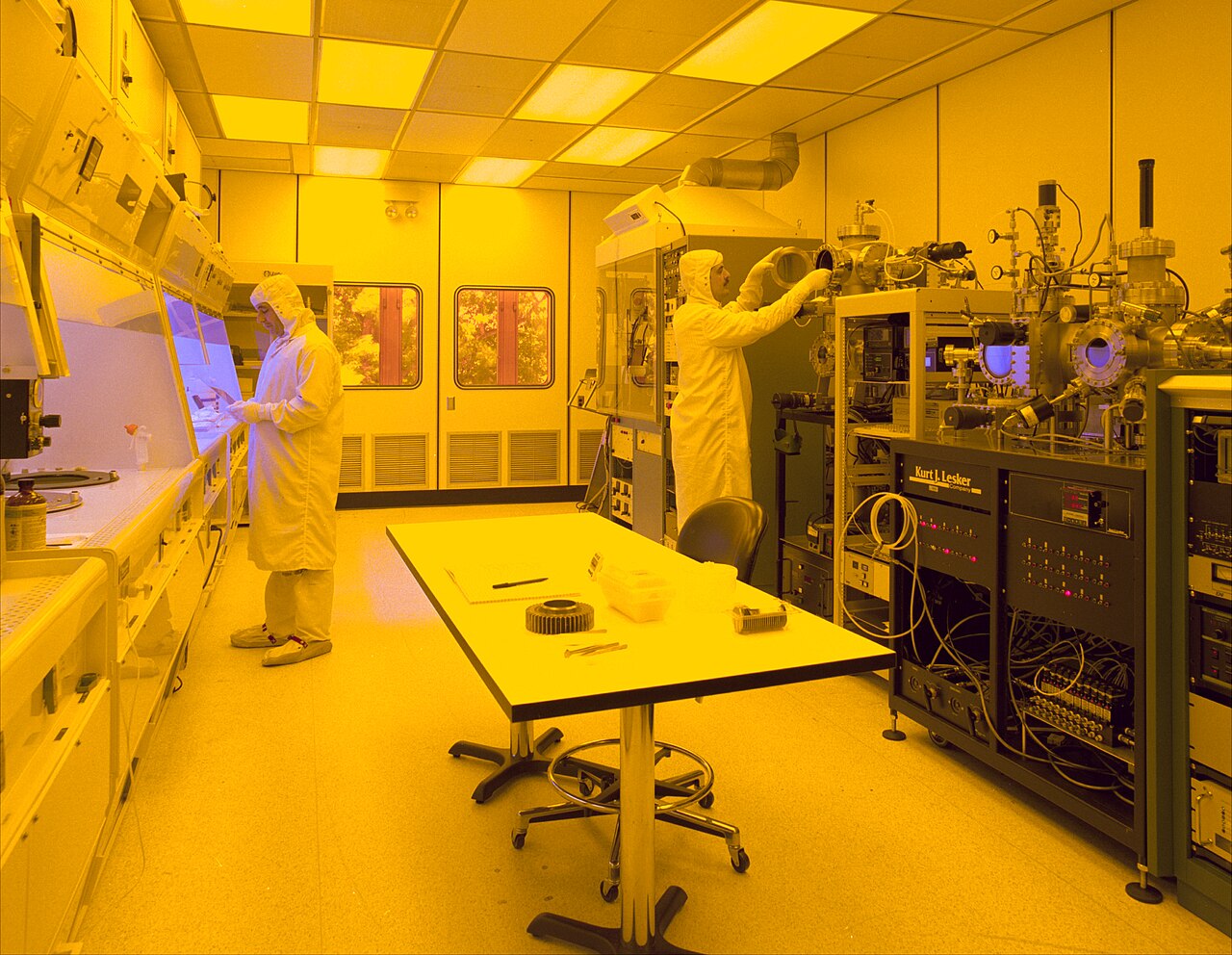
A microfabrication clean room at NASA Glenn Research Center. Photo: NASA via Wikimedia Commons, public domain.
Quick Answer: Three finalized federal CHIPS and Science Act awards direct about $6 billion to Texas semiconductor projects: up to $4.745 billion for Samsung in Taylor and Austin, $900 million for Texas Instruments in Sherman and $380 million for GlobalWafers in Sherman. As of late 2026, two of the three sites are producing, and Samsung’s first Taylor fab is in tool qualification.
Texas was one of the largest winners when the U.S. Commerce Department finalized its CHIPS Act manufacturing awards in December 2024. Two years later, the program has been reshaped in Washington, with equity stakes, a cancelled research consortium and a larger tax credit, while the Texas projects themselves have moved from construction toward production. This article reviews where each one stands, using federal award pages, Congressional Research Service and Government Accountability Office reports, and company disclosures. Figures are stated as of November 26, 2026.
How much CHIPS Act money has Texas received?
The three finalized awards with Texas sites total up to $6.76 billion, of which about $6.03 billion is assigned to Texas locations. The rest supports the same companies’ plants in Utah and Missouri.
| Project | Texas city | Federal award | Company investment | Jobs | Status |
|---|---|---|---|---|---|
| Samsung Electronics | Taylor and Austin | Up to $4.745 billion, final December 20, 2024 | More than $37 billion | 3,500+ manufacturing; 12,000 construction | First fab in tool qualification; volume production planned for 2027 |
| Texas Instruments | Sherman | $900 million of up to $1.61 billion, final December 20, 2024 | More than $18 billion across three fabs, including Utah | 1,500+ manufacturing in Sherman | First fab in production |
| GlobalWafers | Sherman | $380 million of up to $406 million, final December 17, 2024 | $4 billion, including Missouri | About 750 manufacturing; 1,200 construction | Open since May 2025; one of six planned phases running |
| X-Fab | Lubbock | Up to $50 million, preliminary terms | Not available | Not available | No final award as of June 10, 2026 |
Sources: National Institute of Standards and Technology; Congressional Research Service.
For scale, the Government Accountability Office reported that as of July 15, 2026, Commerce had awarded about $31.7 billion in direct funding for 49 projects across 24 companies, plus $6.8 billion in loans to three companies. The roughly $6 billion assigned to Texas sites is about 19% of that national total. On the companies’ own figures, the three Texas-linked awards are tied to about $59 billion in planned private investment, a number that includes the Utah and Missouri plants.
Has the money actually been paid?
CHIPS awards are not paid up front. The Congressional Research Service notes that disbursements are tied to negotiated milestones, with completion dates running from November 2024 to October 2033. Nationally, $13.1 billion had been disbursed as of April 2026, about 42% of direct funding, and $7.865 billion of that went to Intel. Eleven awardees had completed 24 milestones, 125 milestones were in progress and nine were past their expected dates.
The federal reports reviewed for this article do not list payments by project for Samsung or GlobalWafers. Texas Instruments is the exception, because it reports the cash in its financial results.
What has Texas Instruments received and built in Sherman?
Texas Instruments’ final award of up to $1.61 billion supports three 300-millimeter wafer fabs: two in Sherman, north of Dallas, and one in Lehi, Utah. The federal award page assigns $900 million to Sherman. The Sherman fabs are designed to make analog and embedded chips on 65-nanometer to 130-nanometer processes, with anticipated output in the tens of millions of chips a day. The award includes $10 million for workforce development, and the projects are expected to create about 2,000 manufacturing jobs, more than 1,500 of them in Sherman, along with more than 20,000 construction jobs.
In a company post dated December 17, 2025, Texas Instruments said its first Sherman fab was in production and that customers were receiving chips three and a half years after groundbreaking. Analog power products were among the first out of the plant. The company describes the Sherman site as part of a plan to invest more than $60 billion across seven fabs in Texas and Utah.
How much CHIPS cash has TI collected?
The company’s second-quarter 2026 results, reported July 22, 2026, give the clearest view of federal money reaching a Texas chipmaker. The figures are companywide and include Utah.
| Measure | Amount |
|---|---|
| CHIPS incentive proceeds, second quarter 2026 | $549 million |
| CHIPS incentive proceeds, 12 months to June 30, 2026 | $1.179 billion |
| CHIPS incentive proceeds, prior 12 months | $260 million |
| Investment tax credit used, second quarter 2026 | $301 million |
| Investment tax credit used, trailing 12 months | $433 million |
| Total CHIPS-related cash benefit, second quarter 2026 | $850 million |
Source: Texas Instruments second-quarter 2026 financial results.
Adding the two 12-month periods gives about $1.44 billion in incentive proceeds since mid-2024, a large share of the $1.61 billion maximum. At the same time, the company’s capital spending is falling as the heaviest construction phase passes. Capital expenditure was $514 million in the second quarter of 2026, compared with $1.305 billion a year earlier, and $3.312 billion over the trailing 12 months, compared with $4.936 billion. In other words, federal cash is arriving as the company’s own outlays decline, which improves its free cash flow in the near term.
Where does Samsung’s Taylor fab stand?
Samsung holds the largest Texas award and the longest timeline. The final agreement, announced December 20, 2024, provides up to $4.745 billion toward more than $37 billion in expected capital spending. The scope covers two leading-edge 2-nanometer logic fabs and a research and development fab in Taylor, northeast of Austin, plus an expansion of the existing Austin facility. The award page lists more than 3,500 manufacturing jobs, 12,000 construction jobs and $45 million in workforce funding, with all facilities expected to be operational by 2030.
The schedule has moved more than once. Samsung announced the Taylor fab in November 2021 with production planned for 2024, and in December 2023 said full-scale production would slip to 2025, according to the Congressional Research Service.
The most recent status report, published October 16, 2026, by TechPowerUp and drawing on trade press coverage, said tools in the first fab are installed and going through staged qualification on the 2-nanometer process. Operations were planned by the end of 2026, with volume production in 2027. The same report said Samsung planned to break ground on a second Taylor fab in November 2026, a building of roughly 2.7 million square feet with mass production targeted for 2030. Whether that groundbreaking took place this month was not confirmed in the sources reviewed.
Who will buy chips made in Taylor?
Tesla is the anchor customer on record. The two companies have a $16.5 billion agreement running through 2033 that covers Tesla’s AI6 chip. The Korea Times reported in July 2026 that Tesla’s earlier AI5 chip had reached the design hand-off stage and was scheduled for manufacture in Taylor on the 2-nanometer process, citing a since-deleted social media post by a Samsung engineer. Samsung declined to comment on customers.
What is GlobalWafers doing in Sherman?
GlobalWafers makes the silicon wafers that chip factories start with. Its final award of up to $406 million, announced December 17, 2024, assigns $380 million to Sherman, with the balance going to a plant in St. Peters, Missouri. The company expects to spend $4 billion across both sites. Sherman’s share of the jobs is about 750 in manufacturing and 1,200 in construction. The plant produces 300-millimeter silicon wafers and is also slated for silicon carbide epitaxy wafers in 150-millimeter and 200-millimeter sizes.
The Sherman plant opened in May 2025. Tom’s Hardware reported in July 2026 that it is the only operating U.S. facility making advanced 300-millimeter wafers. The 142-acre campus is designed for up to six phases, and one is running.
A private deal announced in 2026 may matter as much as the federal grant. Micron agreed to provide $500 million in strategic financing for the Sherman plant in exchange for a 10-year wafer supply agreement, part of up to $3 billion Micron is committing to its U.S. supply chain. GlobalWafers’ chief executive had previously tied a second phase to long-term contracts, customer prepayments and government support.
How has Washington changed the CHIPS program?
Four changes since early 2025 affect how Texas projects are financed.
A new administrator. An executive order dated March 31, 2025, created the U.S. Investment Accelerator to administer the CHIPS Program Office.
A tougher view of subsidy size. In June 2025, Commerce Secretary Lutnick indicated that a federal share of 4% or less of project value appeared more appropriate, the Congressional Research Service reported. By that yardstick the Texas awards are generous. Samsung’s is about 12.8% of its planned investment, GlobalWafers’ is about 10% and Texas Instruments’ is about 9%. Between January 2025 and April 2026, Commerce amended awards for 14 recipients, according to the Government Accountability Office, which did not name them.
Equity stakes. In August 2025, $8.9 billion of Intel’s funding was converted into a 9.9% government ownership stake. None of the sources reviewed reports an equity stake in, or a renegotiation of, the Samsung, Texas Instruments or GlobalWafers awards. One newer award with a Texas connection does carry equity. USA Rare Earth, which has a site at Sierra Blanca in West Texas along with operations in Oklahoma and South Carolina, received $277 million in direct funding and a $1.3 billion loan across five projects, with the government taking equity and warrants.
A larger tax credit with a deadline. The 2025 budget reconciliation law raised the semiconductor investment tax credit from 25% to 35%. The credit applies only to fabs that begin construction before December 31, 2026. That deadline is now about five weeks away, and it gives companies a strong reason to start any planned building, such as Samsung’s second Taylor fab, before year-end.
What happened to the research money?
The research side of the law has been cut back sharply. Commerce cancelled the roughly $7.4 billion award to Natcast, the nonprofit set up to run the National Semiconductor Technology Center, in August 2025. Natcast laid off its staff and ceased operations the next month. The Government Accountability Office found that Commerce has cancelled research awards representing about $7.8 billion of the $11 billion appropriated, and that a new charter issued in April 2026, under which the department will run the center itself, lacks detail.
What other Texas chip funding is in play?
Among smaller items, X-Fab in Lubbock and Coherent in Sherman received preliminary terms on December 6, 2024, and neither had a final award as of June 10, 2026.
Separate from the CHIPS incentives, the Texas Institute for Electronics at the University of Texas at Austin won $840 million from the Defense Advanced Research Projects Agency in July 2024 for a microelectronics manufacturing center. The Texas Legislature added $552 million, for $1.4 billion in total, and the project involves 50 partners. The state also runs its own semiconductor grant program through the Texas Semiconductor Innovation Fund.
What does this mean for the Texas technology industry?
Two conclusions follow from the record so far. First, the Sherman corridor is ahead of schedule compared with Taylor. Texas Instruments and GlobalWafers are both shipping product from plants in the same city, and Micron’s financing shows private customers are now underwriting expansion there.
Second, the federal contribution is modest next to private capital. About $6 billion in Texas-assigned grants compares with roughly $59 billion in company spending commitments, and the tax credit, at 35%, may prove more valuable to companies than the grants themselves. Texas Instruments used $433 million of that credit in a single 12-month period.
Frequently Asked Questions
How much CHIPS Act funding did Samsung get for Texas?
Up to $4.745 billion in direct funding, finalized December 20, 2024, toward more than $37 billion in planned investment in Taylor and Austin.
Is the Samsung Taylor fab open?
As of an October 2026 report, tools in the first fab were in staged qualification, with operations planned by the end of 2026 and volume production in 2027.
How much is Texas Instruments getting for Sherman?
The federal award page assigns $900 million of TI’s up to $1.61 billion award to Sherman. TI reported $1.179 billion in CHIPS proceeds companywide in the 12 months to June 30, 2026.
What does GlobalWafers make in Sherman?
It makes 300-millimeter silicon wafers, the base material for advanced chips. The plant opened in May 2025 and received $380 million of a $406 million award.
Did the government take equity in Texas chip projects?
No equity stake in the Samsung, Texas Instruments or GlobalWafers awards has been reported in the sources reviewed. USA Rare Earth, which has a West Texas site, did grant equity.
What is the semiconductor tax credit now?
The investment tax credit is 35%, up from 25%, for fabs that begin construction before December 31, 2026.
Sources and Further Reading
- CHIPS for America: Texas state listing, National Institute of Standards and Technology
- Semiconductor Fabrication Facilities Funded by the CHIPS Act: Project Status and Considerations for Congress, Congressional Research Service
- Semiconductors: Commerce Needs Plan to Meet CHIPS for America R&D Requirements, U.S. Government Accountability Office
- Samsung Electronics (Texas) award page, National Institute of Standards and Technology
- Texas Instruments (Texas) award page, National Institute of Standards and Technology
- GlobalWafers (Texas) award page, National Institute of Standards and Technology
- Samsung Taylor Fab Enters Production Phase for Tesla’s AI5 Chip, The Korea Times
- Samsung to Break Ground on Second Taylor Fab in November, Production Targeted for 2030, TechPowerUp
- The Future Starts With the First: Our Newest 300mm Wafer Fab Is in Production, Texas Instruments
- TI Reports Second Quarter 2026 Financial Results and Shareholder Returns, Texas Instruments
- Micron Takes a $500 Million Position in America’s Only 300 mm Wafer Plant, Tom’s Hardware
- UT Awarded $840M to Build Microelectronics Manufacturing Center, University of Texas at Austin