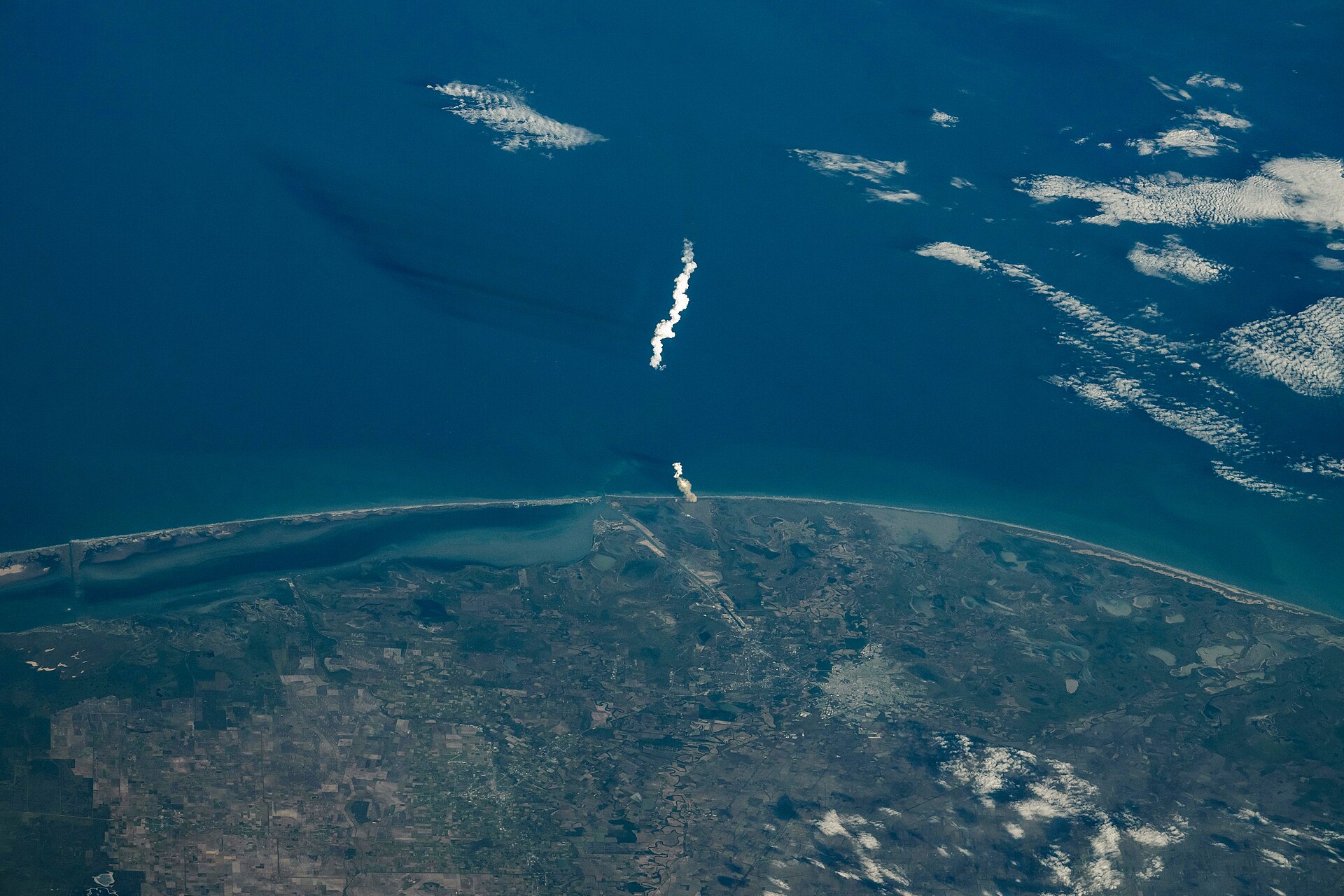
Photo: NASA, via Wikimedia Commons. License: Public domain.
Quick Answer: SpaceX, headquartered at Starbase, Texas, priced its initial public offering at $135 a share and began trading on Nasdaq under the ticker SPCX on June 12, 2026. With the underwriters’ option exercised in full, the sale raised $86.2 billion, valuing the company at about $1.78 trillion. Shares closed at $139.75 on November 11, 2026, a market value near $1.90 trillion.
Five months after the largest stock offering on record, the company that builds Starship on the Texas coast is a public business with quarterly numbers, a prospectus and a share price. That changes how the Texas technology industry can be measured. For the first time, the finances behind the state’s most visible space employer are on the record rather than estimated from private funding rounds. This article walks through what the filings and subsequent reporting show as of November 25, 2026, and what they mean for Texas.
How big was the SpaceX IPO?
It was the largest initial public offering ever completed, by a wide margin. According to a Dealroom analysis of the prospectus published November 12, 2026, SpaceX sold a base of roughly 556 million new shares at $135 each, for $75.0 billion. The banks running the sale then exercised their option to buy another 83 million shares in full, lifting the total to 639 million shares and gross proceeds to $86.2 billion. After costs, the company kept about $85.7 billion.
Two details stand out. First, every share sold was new. No existing shareholder sold stock in the offering, so the entire sum went to the company’s balance sheet. Second, the scale dwarfed the previous record. Coverage of the filing cited Saudi Aramco’s listing as the prior high, at $25.6 billion by Renaissance Capital’s count and $29.4 billion in Bloomberg’s reporting. On either figure, SpaceX raised roughly three times as much.
What was the timeline from filing to first trade?
The process took about two months in public view. SpaceX filed confidentially in April 2026, made its registration statement public on Wednesday, May 20, 2026, and saw its first trade on Friday, June 12, 2026. The filing said the stock would trade on Nasdaq.
| IPO key fact | Detail |
|---|---|
| Headquarters | Starbase, Texas |
| Public filing date | May 20, 2026 |
| First trading day | June 12, 2026 |
| Exchange and ticker | Nasdaq: SPCX |
| Offer price | $135 per share |
| Shares sold (with option) | About 639 million |
| Gross proceeds | $75.0 billion base; $86.2 billion with option |
| Net proceeds | About $85.7 billion |
| Valuation at offer | About $1.78 trillion |
| First-day close | $160.95, about 19% above offer |
How has SpaceX stock traded since the IPO?
The shares have given back most of their opening gain but remain above the offer price. The stock closed its first day at $160.95, roughly 19% over the $135 offer. It finished June at $170.86, then drifted lower through the summer and fall. By September 30 it closed at $150.86, and on November 11, 2026, the most recent close in the data reviewed for this article, it stood at $139.75.
That November close is about 3.5% above the IPO price and about 13% below the first-day close. It still values the company at roughly $1.90 trillion. CBS News Texas reported that market value passed $2 trillion on listing day, which is consistent with the first-day closing price.
| Date (2026) | Close | Change vs. $135 offer |
|---|---|---|
| June 12 (first day) | $160.95 | +19.2% |
| June 30 | $170.86 | +26.6% |
| September 30 | $150.86 | +11.7% |
| November 11 | $139.75 | +3.5% |
Source: Dealroom analysis of SpaceX trading data, November 12, 2026. Percentage changes calculated from the reported closes.
What do SpaceX’s financials actually show?
They show a fast-growing company whose satellite internet arm is profitable and whose artificial intelligence arm is not. The prospectus reported 2025 revenue of $18.7 billion, a figure that includes xAI and the social platform X, which were folded into SpaceX through a merger in February 2026. On that revenue, the combined company posted an operating loss of $2.6 billion.
The segment detail explains the gap. Starlink earned operating income of $4.4 billion on $11.4 billion in revenue in 2025, an operating margin of nearly 39%. The launch business lost about $0.7 billion. The AI segment, which holds xAI and X, lost $6.4 billion. In other words, the connectivity business generated about 61% of revenue and all of the operating profit, and that profit was more than consumed by AI.
How fast is revenue growing in 2026?
Quickly. The filing showed first-quarter 2026 revenue of nearly $4.7 billion. Dealroom’s November analysis put revenue for the first nine months of 2026 at $27.1 billion, including $14.6 billion in the third quarter alone. Nine months of 2026 revenue is therefore about 45% larger than all of 2025.
Starlink remains the engine. The subscriber count stood at about 13.6 million in Dealroom’s November 12 analysis, up from the roughly 10 million cited in earlier coverage of the offering. On the launch side, Scientific American reported 165 launches in 2025, most of them on the Falcon 9 rocket.
| 2025 segment | Operating result | Note |
|---|---|---|
| Starlink (connectivity) | +$4.4 billion | On $11.4 billion of revenue |
| Launch | -$0.7 billion | 165 launches in 2025 |
| AI (xAI and X) | -$6.4 billion | Merged in February 2026 |
| Company total | -$2.6 billion | On $18.7 billion of revenue |
Source: SpaceX prospectus figures as reported by Dealroom and Yahoo Finance. Segment figures are rounded and do not sum exactly to the total.
Where is the IPO money going?
Mostly into computing and rockets, and at a pace that explains why the company raised so much. The prospectus listed AI computing first among its uses of proceeds, according to Dealroom, and Scientific American’s coverage pointed to orbital data centers and Starship development as the stated ambitions.
The spending figures are large even next to an $86 billion raise. Capital expenditures were $20.7 billion in 2025, of which $12.7 billion went to AI. In the first nine months of 2026, capital spending reached $48.1 billion, against $13.1 billion of cash generated by operations. That is roughly $3.70 of investment for every dollar of operating cash flow. SpaceX also raised $25 billion in bonds in the same month as the IPO, bringing the capital raised that month to about $111 billion.
Put differently, nine months of 2026 capital spending equals more than half of the net IPO proceeds. The offering did not create a cash cushion so much as fund a build-out already under way.
What does the IPO mean for Starbase and South Texas?
It ties a publicly traded, trillion-dollar company to a specific stretch of the Texas coast. SpaceX’s headquarters is at Starbase, in the Rio Grande Valley, where Starship is built and launched. A company quarterly impact report cited by CBS News Texas on June 12, 2026, said Starbase had more than 4,000 employees, about 70% of them local, and that the company planned to nearly double that workforce to about 8,000 this year.
The local effects are already visible in housing. Brownsville, a city of about 192,000 people more than 20 miles from the launch site, had an average home price of $196,920 in 2026, according to Zillow data cited by CBS News Texas. That is up nearly 75% from $112,705 in 2018.
Is everyone in the region on board?
No. The same CBS News Texas report included local critics. The group Save RGV said launches have left debris and harmed wildlife and air quality, and a resident interviewed said rising home prices have strained locals. SpaceX did not comment for that report. Those concerns sit alongside the hiring numbers, and both are part of the local ledger.
What are the main risks investors and Texas should watch?
Four risks appear repeatedly in coverage of the prospectus.
- Starship execution. Scientific American noted at the time of the offering that Starship had not reached orbit on any of its 12 test flights to that point. Much of the long-term plan, and much of the Starbase workforce, depends on that vehicle.
- The space data center thesis. Yahoo Finance reported that analysts doubt orbital data centers are feasible in the near term. The prospectus nonetheless puts AI computing first in line for the proceeds.
- Spending ahead of cash flow. Capital expenditures of $48.1 billion in nine months compare with $13.1 billion of operating cash flow.
- Concentrated control. Elon Musk holds about a 46% economic stake, including 1.3 billion unvested shares, and serves as chief executive, chief technology officer and chairman. Wedbush analysts cited by Yahoo Finance said he keeps majority voting power and raised the possibility of a future combination with Tesla.
How does this change the Texas technology picture?
It gives Texas the headquarters of one of the most valuable listed companies in the world, and it makes that company’s economics visible. Three implications follow from the reported numbers.
First, SpaceX is now three businesses under one Texas-based parent: a profitable broadband network, a launch provider running slightly below break-even, and an AI operation absorbing most of the capital. Texans tend to think of the company as a rocket maker. By revenue, it is primarily an internet service provider, and by spending, it is primarily an AI infrastructure builder.
Second, the capital involved is on a different scale from anything else in the state’s startup economy. The $86.2 billion raised in one offering, plus $25 billion in bonds, went to a single Texas-headquartered company. That company’s spending decisions will shape supplier demand, construction and hiring in a way few Texas technology firms can.
Third, public reporting brings discipline and scrutiny. Each quarter, investors will see whether Starlink’s margin holds, whether launch moves into profit and how quickly AI losses narrow. Those results will bear directly on how much the company keeps investing at Starbase and elsewhere in Texas.
Brian’s Take
I spent years as an investment manager and analyst, and what strikes me about these numbers is how different the public SpaceX is from the one most people picture. The rockets get the attention. The filings say Starlink pays the bills, with $4.4 billion of operating income in 2025, and the AI segment spends that and more. Anyone judging what this company means for Texas should start there.
The second thing I notice is the ratio of spending to cash flow. Putting $48.1 billion into capital projects in nine months while operations generate $13.1 billion is a bet that requires open capital markets. The IPO and the $25 billion bond sale show the markets were open in June. That is a fact about June, not a guarantee about the future.
For Texas business, the practical point is that the Starbase hiring plan, from more than 4,000 workers toward about 8,000, now sits inside a company that has to report its progress every 90 days. That is healthy. Suppliers, local governments and workers in the Rio Grande Valley will have far better information than they had a year ago.
Frequently Asked Questions
When did SpaceX go public?
SpaceX shares began trading on Nasdaq on June 12, 2026, under the ticker SPCX. The company filed its registration statement publicly on May 20, 2026.
How much did SpaceX raise in its IPO?
The base offering raised $75.0 billion at $135 a share. With the underwriters’ option exercised in full, gross proceeds reached $86.2 billion, or about $85.7 billion after costs.
What is SpaceX worth now?
At the November 11, 2026 close of $139.75, the company’s market value was about $1.90 trillion, compared with about $1.78 trillion at the offer price.
Is SpaceX profitable?
Not at the operating level in 2025. The company reported a $2.6 billion operating loss on $18.7 billion of revenue. Starlink was profitable, while launch and AI lost money.
Where is SpaceX headquartered?
At Starbase, Texas, in the Rio Grande Valley. A company report cited in June 2026 put the Starbase workforce at more than 4,000, with plans to reach about 8,000.
Did existing shareholders sell in the IPO?
No. All shares sold were newly issued, so the proceeds went to the company.
Sources and Further Reading
- SpaceX IPO chart analysis and prospectus figures, November 2026 – Dealroom
- SpaceX’s Historic IPO Ignites the New Space Race – Scientific American
- SpaceX IPO and Starbase, Brownsville coverage, June 12, 2026 – CBS News Texas
- SpaceX files for IPO: prospectus coverage, May 21, 2026 – Yahoo Finance
- Elon Musk-led SpaceX files for stock listing, May 20, 2026 – Yahoo Finance
- Elon Musk-led SpaceX files publicly for stock listing – ABC News